

Part 1: The Good Was Already There
Part 2: The Coherence Was Already There
Part 3: The Blueprint Was Already There
Part 4: When Divine Love Takes Social Form
Part 5: When Love Becomes Social Architecture
Part 6: When Love Becomes People Power
PART FIVE — When Love Becomes Social Architecture
Living Experiments With Common Life
Connecting the good was not the destination. It was where the next stage began.
That first conversation with one farmer had led me into an entire web of relationships I had barely noticed before. I began meeting farmers and ranchers, restaurant owners, people running farmers’ markets and food banks, educators, consumers, foodies, and local business owners. The more relationships we formed, the more I could see that these seemingly separate people and activities were already interconnected as parts of a larger whole.
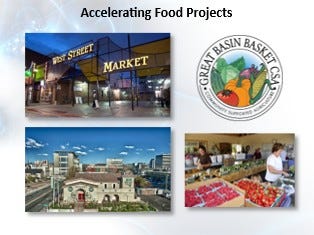
As I looked back, I realized this had not begun with food. My first experiment with this relational approach had been back in 1991 in Logan Heights, an urban San Diego neighborhood struggling with drug dealing, gang violence, and poverty. Instinctively, I brought together community leaders—including a priest and a minister, as well as others who had never met—to address all of those common problems.
On two streets in the neighborhood, roughly forty drug dealers were selling openly, while the San Diego Police Department seemed largely unwilling or unable to stop it. We began by organizing local residents to march for peace through the neighborhood once a week—to literally take back their streets.
Then I brought together men from the community and religious leaders from very different backgrounds, including a Catholic priest from a Hispanic church, Black Baptist ministers, and other religious leaders from outside the neighborhood. Night after night, we marched to the corner where the drug dealers were operating with a simple message: “We love you as a child of God, but we don’t love what you are doing to this community.”
Over time, the dealers left. We had literally helped the neighborhood reclaim those streets. But something else had happened as well. We had activated a whole grassroots community and built new relationships among leaders, congregations, and groups that had previously been largely disconnected from one another.


By connecting previously separate groups across the community, these relationships were creating a new relational architecture.
It remained long after the immediate crisis had passed, opening the way for other forms of cooperation, including the creation of a thriving food co-op that became a locally owned neighborhood store, bringing healthy food into a community where fresh food had been difficult to find.
Again, there was no conversion taking place, and we weren’t gathering for the usual kind of interfaith dialogue, learning about one another’s beliefs in the hope of greater tolerance. This was a radically different approach.
Together, we were putting into action the Love our different faiths taught us to live.
Standing together in those streets, we were bearing witness to Love in the public square.
We were building relationships by working together on challenges that mattered to everyone. The relationships grew through the work, and as trust grew, new possibilities for cooperation emerged.
Later, in Reno, we developed a Local Economy Network in 2003, followed by the Local Food System Network in 2005. The settings and needs were very different, yet the same relational pattern kept taking form.
The Coherence of the Whole
I began to wonder: What else might it generate?
That question expanded the way I looked at community life. I started noticing how much of our daily lives was organized around needs we all shared. People need food and water, housing, health and wellness, arts and culture, education and mentoring, livelihoods and a healthy local economy. They need safe neighborhoods, care for the natural environment, and places where faith and spirituality can find expression through service.
In communities everywhere, people are already meeting these needs through businesses, nonprofits, faith communities, civic groups, and local government agencies. Yet much of that good work remains disconnected, even when people are serving the same community.
I knew how a community could cohere around a shared way of seeing the world. I had experienced and helped create this in progressive, ecological, and systems-change movements, as well as in consciousness and spiritual communities, and the Christian church. People could form strong relationships and inspire deep commitment within these communities.
But I had been confusing coherence within a part with coherence of the whole.
Here is the “normal” and largely unconscious pattern inside the Culture of Separation:
We gather with people who think as we do, build a community around our shared beliefs, and then try to get others to join our group, cause, or movement. There can be tremendous good within these communities. But they can also become islands of coherence within a society growing all the more disconnected.
The reality is, a whole community is made of people who think very differently from one another. If coming together required others to first see the world as we did, we would simply create another island and ask everyone else to join it.
Yet my earlier experiences had also taught me that agreement was not the only thing that could connect us.
Beneath our different ways of seeing the world was a relational order in which we already participated, rooted, as I understood it, in Divine Love.
Now I was putting what I had learned about this deeper coherence into practice in my community work. And if that underlying belonging was real, it had to become more than an idea. We needed to live it in how we related to one another and what we did together.
I also discovered the “secret sauce” to making the ideal real.
The Virtues of love, respect, integrity, courage, and service showed me how Divine Love became embodied in us and in our relationships. We did not have to see the world the same way to practice them with one another.
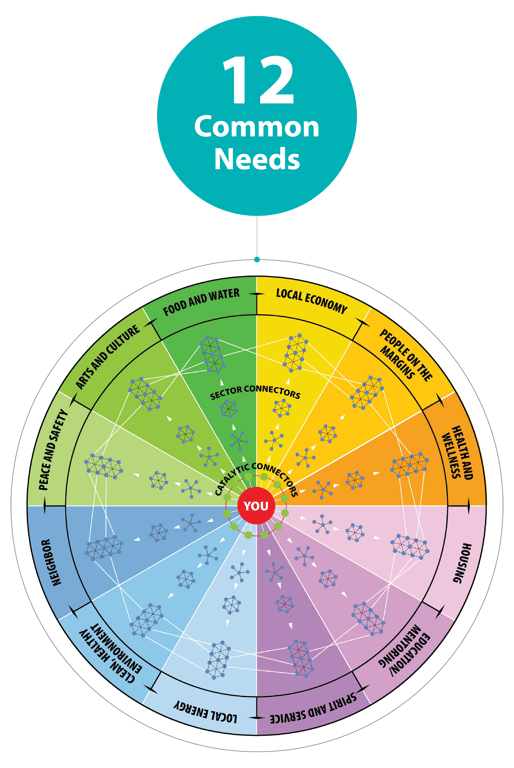
The Common Needs gave us places to put those virtues into action. Food, health, the environment, the economy, shelter, livelihood, education, and the other basic needs of community life did not require us to think alike. We already shared them. They gave us common ground for working together.
We were not creating that coherence by connecting the parts. We were giving expression to a coherence that was already there.
What was missing were the relationships that allowed people to recognize it and give it social form. People were already working to meet these needs, each carrying a piece of the larger whole, often without recognizing how deeply their work was connected.
Nor had I invented the idea of organizing community around shared human needs. I had first encountered it through Sarvodaya and its ten basic needs in Sri Lankan villages. Years later, working in a very different Western urban setting, our experience led us to identify twelve Common Needs. The cultures and circumstances were different. The underlying human needs were not.
The distinction mattered. Issues could easily divide us into positions, while Common Needs gave us shared places to serve. Every community had to feed its people, care for its health, educate its young, provide places to live, sustain livelihoods, and nurture its cultural and spiritual life. Together, the Virtues and Common Needs offered a simple foundation for Love in action: shared Virtues practiced in meeting Common Needs.
And as I looked across the community through this lens, something else became visible. The good we were trying to connect was already there, distributed throughout the whole.
The conventional farmer and the regenerative farmer were both part of feeding the community. The progressive and the conservative both depended upon its economy, schools, neighborhoods, and health. Churches, secular organizations, businesses, nonprofits, citizens, and government agencies were already carrying different pieces of its common life.
Each contributed to the good, whether or not they shared our worldview.
The farmer who had once told me, “I’m already doing it,” was helping me see something I had not fully understood at the time. He did not have to join our movement or share our vision of a better society. He already belonged. He was already part of feeding the community. He already carried a piece of the good.
From Islands of Coherence to Whole Communities
If the good was already distributed throughout the community, then food was only one place where it could be connected. Other people were already carrying pieces of that good through neighborhoods, health, education, local business, the arts, the environment, faith communities, and other areas of shared life.
And I did not have to be the one connecting all of it. Other uniters could emerge around these different areas, each building relationships from where they already stood.
The fractal pattern I had been seeing was now taking form at another scale. One person holding space could bring together a small circle. That circle could grow into a wider network. And now the same pattern could emerge around many Common Needs at once, with uniters weaving relationships around each one. No one person had to organize or control the whole.
But something else became clear. These networks could themselves become isolated islands of coherence. A local food network could become highly connected within itself while remaining disconnected from the health network, the neighborhood network, faith communities, or the local economy around it.
Coherent islands do not make a coherent whole community.
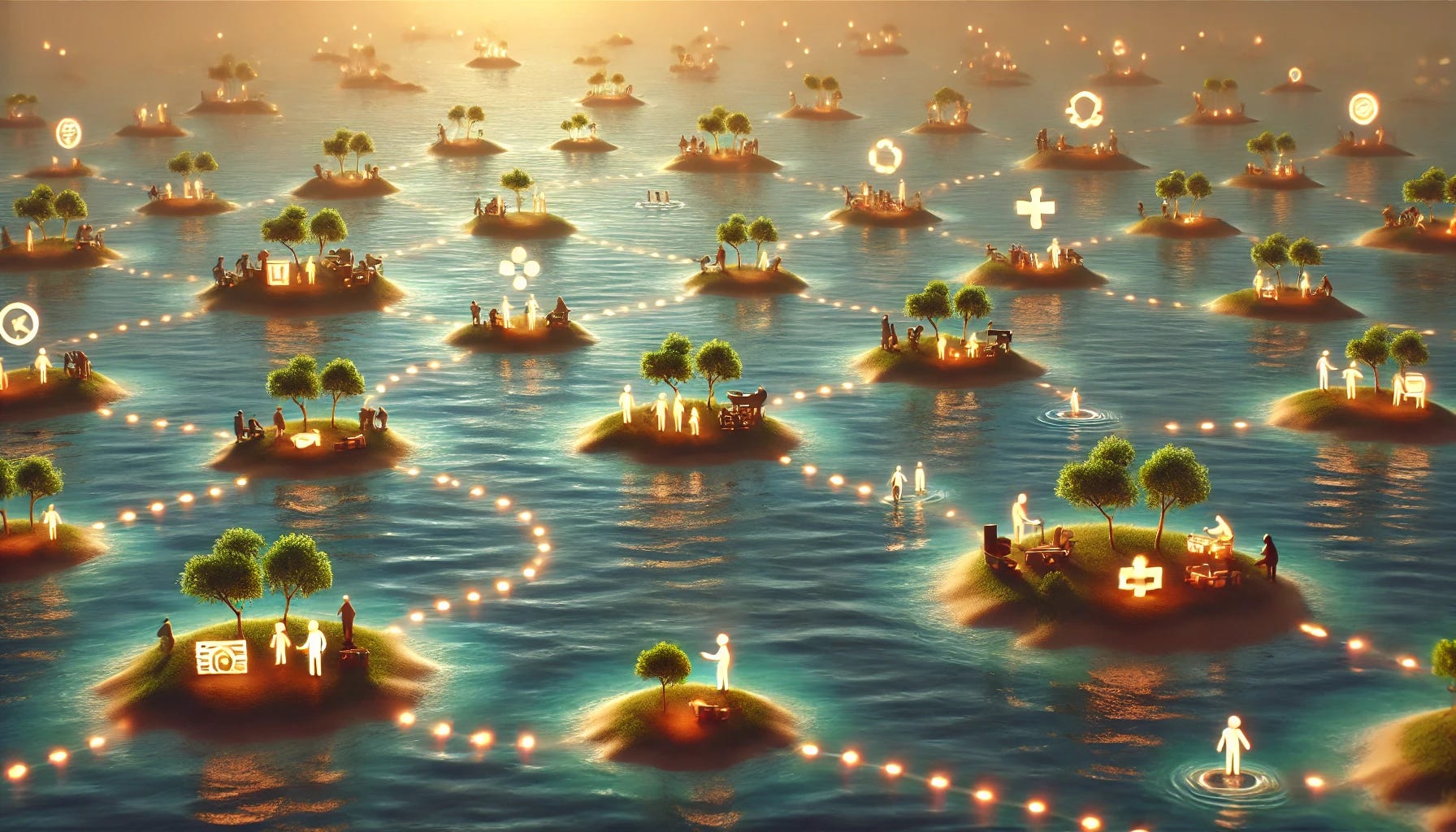
And even when these islands connect with others that share a similar vision, they can simply form a larger island of people who already see the world in much the same way. The network may become larger and more influential while the surrounding community remains outside it.
It was only through my experience in real-world communities that I began to see this.
For years, I had assumed that if enough people joined our separate movements, eventually they would grow large enough to transform society. I could now see the contradiction more clearly. We were trying to overcome a Culture of Separation while our very strategy kept us apart from the larger community.
Without relationships extending beyond our islands and into the larger community, we’d be building alternatives alongside society but not transforming the larger whole.
What we lacked was the connective tissue that could weave these separate networks into the larger life of the community.
Then I realized that the same approach we used to connect individuals could also link networks. Much of our network building had grown through trusted third-party connections: one person connecting two others who might otherwise never have found each other. A trusted person could do the same between networks, and this became the basis for creating connections across the community.
The needs themselves were not isolated. Food was connected to health, education to children and families, local businesses to livelihoods, and faith communities to service. Housing, environment, safety, culture, and economic life were all intertwined in ways our separate networks and organizations often obscured.
The community itself began to look different to me.
It was not simply a collection of organizations, institutions, movements, and projects occupying the same place. It was a social ecology whose parts were already deeply interdependent, even if they did not always recognize themselves as part of a larger whole and the relationships among them remained fragmented.
For much of my life, I had participated in movements that gathered people around a vision of a better world and then sought to spread that vision into the larger society. I had come to see this as a “conversion” model of social change. Over decades of working at the grassroots, I began to see a fundamentally different approach.
Instead of trying to bring more people into our coherent community, we were building relationships with people who did not necessarily share our worldview.
We were connecting people and networks across the larger community without requiring agreement first.
The goal was not to enlarge our island. The goal was a whole community.
We had already seen this happening in our food, local economy, and other community networks. Each had grown through relationships among people from different parts of the community, and none belonged to a single organization.
That was what excited me. These networks did not need anyone to own or control them. What held them together were the relationships among the participants and the mutual value they found in being connected.
Just as no single person had to hold a whole network, no single organization or movement had to hold the whole community.
As these connections multiplied, a relational infrastructure began to form across the community, linking networks without placing any one of them at the center.
I did not have a name for it then, but I was beginning to see the same pattern at every scale. Relationships connected people into circles, circles grew into networks, and relationships between networks began connecting with one another across the larger community. I would eventually come to understand this as the Ancient Blueprint taking social form.
The forms were emerging, but the underlying coherence was already there. We were not trying to align everyone around a single conception of the good.
We were building relationships among people and networks already carrying pieces of the good throughout the community, allowing the different parts to recognize their place within the whole.
Eventually, I came to call this process of connecting the people and networks carrying the good throughout a community Connecting the Good. As these relationships grew, the separate parts of community life could begin to function as a more coherent whole.
The islands did not disappear. Nor did they need to. Each could remain distinct, carrying its own gifts, relationships, and ways of serving. They could become more deeply connected without becoming the alike.
The aim was not to replace these different communities and networks with a single coherent community of our own. It was to weave relationships among them so that the existing community, in all its differences, could become more coherent.
As relationships grew across these differences, the islands remained, but they were no longer isolated. They became the building blocks of a whole community.
Love as the Architecture Between Us
As the relationships between these different networks grew, something more began to happen. Connecting the parts was only the beginning. The relationships themselves were giving rise to something new.
I had already glimpsed this in our own networks.
I remember one evening when we covered the walls with butcher paper and asked people to name locally owned businesses they actually knew. One by one, people stood up and added names. Before long, nearly 150 businesses covered the walls. Only later did I realize that we had mapped more than businesses. We had mapped not just a local economy, but a web of relationships and trust.
And as that web widened, something else became apparent. We weren’t bringing together only businesses that already thought of themselves as green, or food producers who identified as organic or regenerative.
We were starting with the community as it already existed and bringing people into relationship across those differences.
Ironically, widening the circle strengthened the more focused networks. Rather than diluting them, it gave them a larger ecosystem of relationships, customers, collaborators, and potential allies in which to grow. They could deepen their particular work without making it the boundary of the community itself.
I saw this happen with the very first farmer I had called years earlier. When we met, he was a conventional farmer with few connections to the urban community in Reno. Over the years, as his relationships within the community grew, so did the possibilities for his farm.
With a growing market for his produce, he expanded into organic farming and became one of our strongest supporters of farm-to-table and community-supported agriculture. Years later, whenever I saw him at community events, he would still thank me for that first connection—for helping expand both his business and his relationships with the broader community.
We had welcomed him as he was, without requiring him to embrace an organic or regenerative vision of farming as a condition for belonging. The larger food system gave us common ground where people with very different ideas about farming could begin working together.
Through the relationships that followed, strengthening the existing food system created new possibilities for everyone. Conventional and organic farmers, restaurants, consumers, and the more focused food networks could each grow without requiring the others to become like them.
I began to see something deeper in this.
If Love meant that we belonged to one another before we agreed on what the future should look like, then it changed how we built the alternative itself.
We did not have to separate ourselves from the system we hoped to change or build a separate world and wait for others to join it. The new could grow within the larger community, in relationship with the people and institutions already there.
Love was becoming an architecture precisely because it made room for difference before agreement. And that changed what we could build together.
I could see this new architecture taking shape in very ordinary ways.
I saw it among restaurant owners who had once regarded one another mainly as competitors. As they got to know one another, they began sharing what they knew, helping one another, and finding ways to collaborate. Farmers connected with restaurants looking for local food. Business owners began referring customers to one another. They didn’t need a new theory of cooperation. As relationships and trust grew, cooperation naturally happened on its own.
It worked because it worked!
At the time, I did not think of this as economic infrastructure. I thought we were simply building relationships.
Only later did I see something deeper: as Love took form in those relationships, it shaped the economic structures we built together.
Becoming a businessman had already begun changing the way I thought about economic life. For years, I had looked at business largely through the eyes of a progressive activist, criticizing a world I had never really inhabited. Now I was inside it, in relationship with people I had once mostly seen through the lens of my own worldview.
Now I was not only a business owner, but a husband, father, neighbor, customer, and member of a community. I was working alongside people trying to make a living, support their families, build businesses, and contribute something of value to their community.
I still saw much that needed to change. But as I came to know these people and experience economic life from within, I also began to recognize some of the prejudice I had carried toward the business world.
That recognition didn’t lessen my desire for fundamental change. What was changing was my understanding of where change begins. For years I had tried to gather people around a shared vision of a better future and extend that vision into society. Now I was discovering another path.
Transformation could begin when people who saw the world differently entered into relationship around the shared needs of their community.
I remember a conversation with a friend who used the term “post-capitalist” to describe the New Economy network he was helping to build. When I questioned the term, he thought I was asking him to stop using it. But that wasn’t my concern. If the term expressed the convictions of his network, they should be free to use it.
I had experienced this tension myself at a New Economy conference in 2017.
I was sitting in a room with about twenty wonderful people envisioning a different economic future. They spoke of cooperatives, the commons, and other alternatives to the dominant economy. I shared much of what they hoped to create. But as I listened, I gradually began to feel as though I were in the wrong room.
Finally, I raised my hand. “I’ve been listening to your vision of the future,” I said, “and I don’t feel welcome here. I own a private corporation, and I don’t feel like there’s a place for me in the future you’re describing.”
That experience stayed with me. The problem was not that cooperatives or the commons did not belong in the future. They did. The question was whether any one vision of the future had to become the condition for everyone else’s belonging.
I began seeing this same tension in many of the emerging economic movements I admired. Regenerative, Doughnut, solidarity, gift, sharing, circular, post-capitalist, and other approaches were generating important insights, experimentation, and strong networks around particular visions of economic life.
But these specialized networks were still only parts of the community. Some of the most important work, I was discovering, happened beyond their boundaries—among people, businesses, organizations, and institutions that did not share the same vision, yet could still find ways to work together.
I was beginning to recognize how deeply the logic of separation had shaped even the way we tried to build community. We gathered around shared visions and then built outward from there.
But the community was already there, filled with people who saw the world differently yet still belonged to one another. Building relationships across those differences was not a side strategy to the work of transformation.
It was becoming part of its architecture.
This was also changing the way I thought about the economy itself. I became less interested in deciding which economic forms belonged in the future and more interested in how different forms could serve the life of the community here and now. People could give and share, buy and sell, lend and invest, volunteer or simply help a neighbor. They could create businesses, nonprofits, cooperatives, land trusts, and informal associations. Sometimes no organization was needed at all.
Just as I did not want to exclude a conventional farmer because he had not yet become organic, I did not want a particular economic philosophy or organizational form to become the price of admission. Different forms could remain different and still participate in the life of the larger community.
The form mattered, but something came before the form.
I had watched relationships open new possibilities for how people exchanged, shared, and worked together. Now I was seeing that this pattern went deeper still.
Divine Love, received within us, takes form as Virtue. Virtue shapes how we relate to one another, relationships create trust, and trust opens new possibilities for how we exchange, share, produce, serve, and steward what we have.
I would later discover that Pope Benedict XVI had given a name to this dimension of economic life: gratuitousness, the spirit of gift. I recognized it immediately. It was what I had witnessed in Dr. Ari and had been struggling to practice myself: the movement from self-centered love toward self-giving Love. The question slowly shifts from “What can I get?” to “What can I give?”
This did not mean replacing markets with a gift economy. People could still buy and sell, compete, earn profits, build businesses, or simply give something away. What gratuitousness changed was something deeper: it brought the Gift of Self into those relationships. A transaction could remain a transaction, while also becoming an opportunity to serve, build trust, create mutual benefit, and contribute to the flourishing of the community.
Love was becoming more than the architecture between us. It was taking form in the ways we shared our gifts, met one another’s needs, exchanged value, and stewarded what we had.
When Love Circulates Through Economic Life
If the deepest movement within us was from self-centered love toward self-giving Love, then what happened when that Love flowed into the ways we created, shared, and exchanged things of value with one another?
I was beginning to see that wealth itself went deeper than money or material assets. It involved not only with what we possessed, but the quality of the relationships between us and in the kind of people we were becoming. What had begun as social infrastructure was beginning to take economic form.
But what did I mean by wealth?
Money mattered, of course. Businesses needed revenue. People needed livelihoods. Families needed homes and food. Communities needed investment and productive enterprise. But money was not the only form of wealth I was seeing around me.
A retired person had decades of knowledge. A church had an unused room. A business owner had relationships and experience. A farmer had land and equipment. A young person had energy and creativity. A neighborhood had people willing to help one another. An organization had volunteers. Someone else knew exactly the person another person needed to meet.
Communities were rich with forms of wealth that rarely appeared on a balance sheet: relationships, knowledge, skills, trust, creativity, generosity, cultural memory, spiritual depth, land, buildings, institutions, and, perhaps most important, people’s willingness to serve.
And underneath many of these forms of wealth was something even less visible. I eventually came to call it Spiritual Capital.
Spiritual Capital is the relational wealth that grows as self-giving Love takes form between us. It doesn’t live in banks or spreadsheets. It lives between us: in generosity offered, trust earned, commitments honored, fairness practiced, and our willingness to serve one another and seek each other’s good.
Much of the community’s wealth was already present, but disconnected. The good, the relationships, and the resources of the community were there. What was missing was the web that could connect them into a larger whole.
I had come to think of these as “frozen assets”—untapped value trapped in the siloed and disconnected structures of community life.
As new pathways of relationship formed across those separations, trust and generosity began to unlock those assets, allowing value to flow where it had previously been blocked.
Bringing people together did more than make that hidden wealth visible. The connections themselves also generated something new: relational wealth. As relationships deepened, value began to circulate. I started noticing the possibilities everywhere.
Someone with decades of experience could share what they knew with someone just starting out. A church room sitting empty during the week could become a place for people to gather. A farmer could find a restaurant looking for local food. A business owner could make the introduction someone else needed. A young person could find a mentor. Someone with resources could help a local enterprise get started. And sometimes what a person had to give was simply their time, their care, or their willingness to help.
Some of this value moved through money. Much of it did not.
Spiritual Capital did not replace financial or material wealth. It strengthened the trust through which other forms of wealth could be shared, exchanged, and put to use.
I was beginning to see the marketplace differently.
For years I had thought about economic life through a familiar divide: capitalism on one side, socialism or collectivism on the other. But the more I worked with local businesses and communities, the less that divide seemed to explain what I was seeing.
What people around me called capitalism increasingly looked like something else: a form of global corporatism where corporate and political power had become concentrated and intertwined.
But resisting that system did not require rejecting markets themselves. Markets long predated these ideologies and grew out of the basic human practice of exchange.
People had always found ways to create, give, share, barter, buy, sell, lend, and invest. Markets themselves were not what I had been questioning. The question was what kind of relationships and values shaped those exchanges. When economic life remained rooted in relationship and moral responsibility, what we had to offer could become a means of serving one another.
For all their differences, I was beginning to see something fundamental these competing systems shared: a materialist understanding of economic life. In its starkest form, materialism told us that matter was the only thing that mattered. Human beings were understood primarily as economic actors—producers, consumers, workers, owners, members of classes—and organizing material life became the central problem.
But the more I saw value arising through people’s gifts, relationships, trust, and service, the more I found myself asking a different question: Where did value come from in the first place? The answer could not be found in an economic system alone.
I realized that economic life began with human beings and the gifts they carried. How those gifts entered the economy depended in part on the relationships and values that shaped how they were offered.
Seen this way, a family business could belong. So could a cooperative, a nonprofit, a corporation, a land trust, or someone simply giving time to a neighbor. What mattered was not that everyone adopted the same economic model, but whether what we were doing together was increasingly shaped by trust, reciprocity, service, and mutual benefit. That realization opened the circle rather than narrowing it.
Restaurant owners could still compete for customers. The organic farmer could still advocate for organic agriculture. Businesses could still make profits. People and organizations did not have to surrender their particular interests. They could pursue those interests while also seeing how they might serve the larger whole.
Ownership could be understood not simply as possession, but as stewardship of what had been entrusted to us. Exchange could include reciprocity and gift. Enterprise could contribute not only to individual success but to the flourishing of the community around it. The economy did not cease to be an economy. But another logic was beginning to move within it.
I would later discover that this was closer to Adam Smith’s original view of economic life than the caricature of self-interest I had associated with capitalism. Smith was a moral philosopher before he wrote The Wealth of Nations, and his understanding of human beings included sympathy and concern for the well-being of others.
In The Theory of Moral Sentiments, Smith wrote, “How selfish soever man may be supposed, there are evidently some principles in his nature which interest him in the fortune of others...”
Markets did not eliminate the need for Virtue. They depended upon it. Economic freedom alone was not enough; it required virtuous participation.
A transaction could do more than exchange value. It could also generate trust, deepen relationship, and create new Spiritual Capital.
This was what I came to understand as a Virtuous Economy.
It did not begin with designing the perfect economic system, but with something much closer to home: the human heart. As we moved from self-centered love toward self-giving Love, we became more capable of bringing trust, generosity, service, stewardship, and care into whatever economic forms we inhabited.
This was not simply spiritual language attached to the marketplace. Divine Love took economic form as our gifts were offered in service to real human needs, and as Virtue shaped how we related, exchanged value, and used what had been entrusted to us.
And as all these forms of value began circulating through these relationships, I began to wonder what might happen if this occurred not only within individual networks, but across the life of an entire community.
What kind of social reality might begin to emerge then? Find out in the LAST PART 6.
Why Coherence Must Precede Our Strategies for Social Change
Part 1: The Good Was Already There
Part 2: The Coherence Was Already There
Part 3: The Blueprint Was Already There
Part 4: When Divine Love Takes Social Form
Part 5: When Love Becomes Social Architecture
To learn more about the Book click HERE, or purchase below:
