

Part 1: The Good Was Already There
Part 2: The Coherence Was Already There
Part 3: The Blueprint Was Already There
Part 4: When Divine Love Takes Social Form
Part 5: When Love Becomes Social Architecture
Part 6: When Love Becomes People Power
PART THREE: The Blueprint Was Already There
Introduction
What I discovered through my own experience in community was not new at all. Over time, I began to recognize the same ancient pattern appearing again and again across very different cultures, spiritual traditions, and periods of profound social upheaval.
And that began to change how I understood my own search. Perhaps I wasn’t trying to invent a new movement or a new system at all. Perhaps I was rediscovering something much older. It wasn’t another ideology people had to follow or a worldview everyone had to share.
The same deeper relational order seemed to be taking form among people with very different worldviews, across cultures, spiritual traditions, and historical circumstances.
The Lineage of the Ancient Blueprint
For much of my life, I thought I was searching for a new way to build community.
Only in retrospect did I begin to recognize the lineage I had been following. It began for me with Jesus—with the Love he embodied in his life, and with the early Christian communities that sought to give that Love social form while living within the Roman Empire.
But I first experienced the pattern personally through the encounter with Jesus I described earlier. In that vision, I saw what I would later understand as two dimensions of a single reality. There was a vertical relationship with the Transcendent, where I experienced being Loved, and that Love then moved horizontally through people and communities.
I saw that Love spreading outward until it seemed to encompass the world. But I was left with a question I did not know how to answer:
How could this be made real?
If Divine Love was more than a personal spiritual experience, how could it become embodied in families, neighborhoods, communities, economies, and the structures of everyday life?
Years later, I encountered a living example that helped me begin to answer that question—from a direction I never expected.
That’s when Jesus sent me a Buddhist.
In the early 1990s, I discovered the work of Dr. A. T. Ariyaratne—Dr. Ari—and the Sarvodaya Shramadana movement he had helped build in Sri Lanka—a national network of over 5,000 communities. Over time, Ari became more than someone whose work I studied. I came to know him personally as a friend, colleague, and mentor.
What struck me most was not simply the extraordinary reach of Sarvodaya, but the seamless way Ari brought together spiritual awakening and community transformation.
Modern Western culture had taught me to separate these worlds.
Spirituality belonged to churches, temples, meditation groups, or private belief.
Community development belonged to nonprofits, governments, programs, and institutions.
Ari made no such separation.
In Sarvodaya, awakening happened at the level of the person, families, and the village at the same time. They were not separate kinds of transformation, but dimensions of a single process. Spiritual development flowed from Love directly into service, shared labor, meeting human needs, economic cooperation, and eventually the structures through which communities could increasingly shape their own lives.
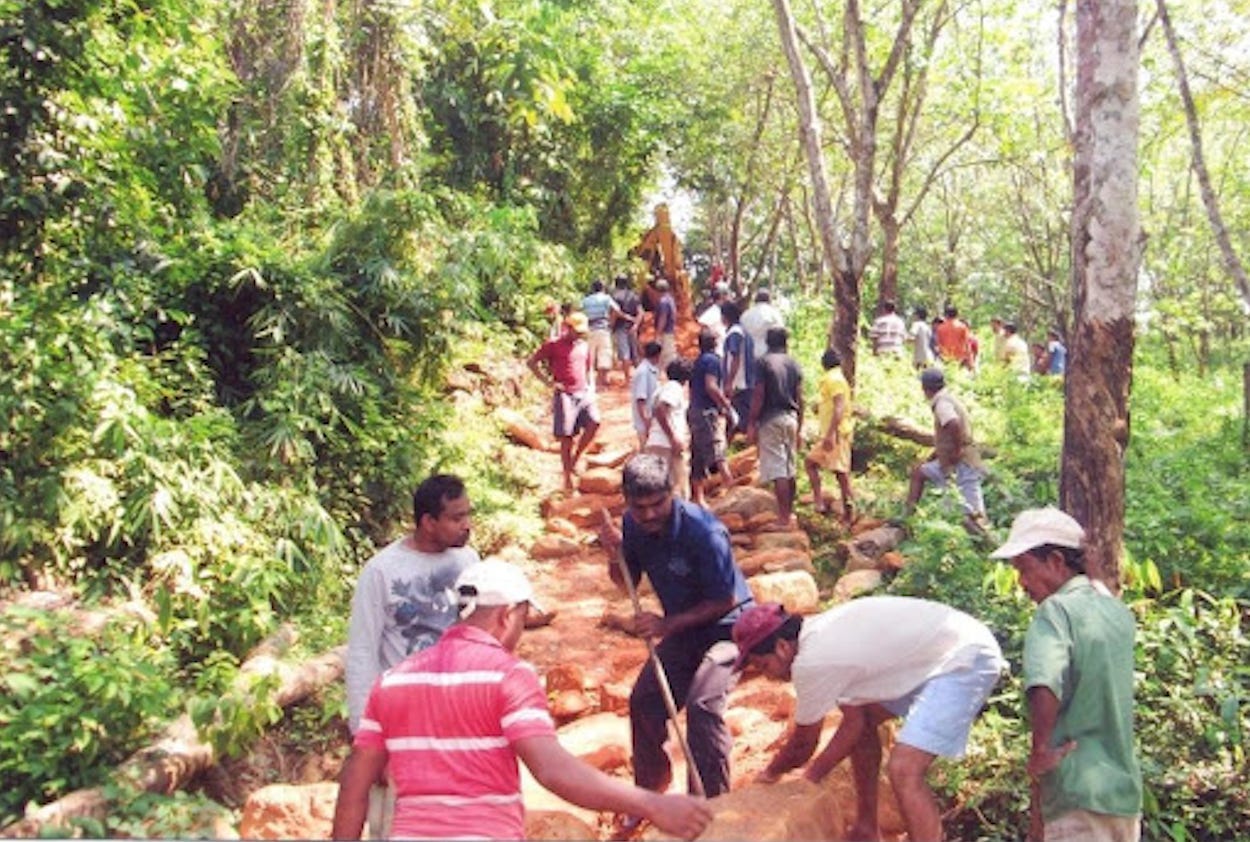
Ari was showing me that what I had learned in the West to separate—spiritual awakening and social transformation—were actually part of the same process.
I tried to translate what I was learning about Sarvodaya into a vastly different world.
In San Diego, in the early 1990s that meant working in Logan Heights, a predominantly Black and Hispanic community of roughly 50,000 people confronting poverty, drugs, gangs, and drive-by shootings. Sri Lankan village development could not simply be imported into an American inner-city neighborhood. The forms had to change, but I began to wonder whether the deeper pattern could remain.
Could everyday people become protagonists in transforming their community? Could relationship and service come before programs? Could communities organize around their own capacities and needs rather than waiting for institutions from outside to rescue them?
I did not yet have the language of Symbiotic Culture. I was experimenting, translating, learning, and sometimes failing. That’s when another piece of the lineage came into view.
Reading more deeply about Gandhi, I discovered how profoundly the Sermon on the Mount had affected him, particularly Jesus’ teaching on nonresistance to evil. But Gandhi did not see transformation simply as resistance to British rule.
Alongside nonviolent resistance was a constructive program: rebuilding village life and local economies, strengthening local self-reliance, addressing education, restoring dignity, reconciling divisions, and creating the social foundations of a new India.
It was Gandhi’s concept of Sarvodaya—the welfare of all—that inspired Dr. Ari to reinterpret the idea through Buddhist teachings and Sri Lankan culture as the Awakening of All, and put it into practice across thousands of villages.
For me, the idea had traveled an extraordinary circle—from one tradition and culture into another, and now back again. I had asked Jesus how Love could become social reality. A Buddhist had helped show me how. And behind the Buddhist stood Gandhi, who had himself been deeply moved by the teachings of Jesus.
The Pattern Across Civilizations
Decades later, while writing this book, I saw this pattern emerge in a place and tradition seemingly far removed from all of them.
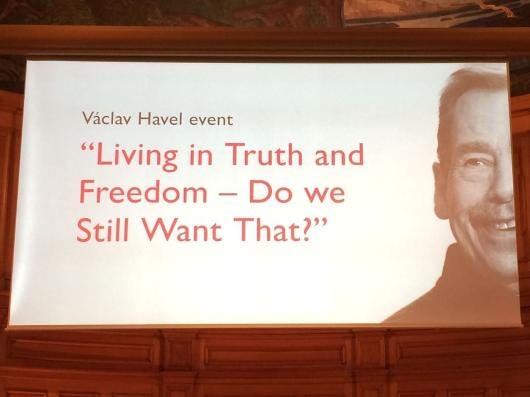
Under Communist rule in Czechoslovakia, Václav Havel, Václav Benda and the dissidents around Charter 77 spoke of living in truth rather than allowing their lives to be absorbed into the lies of the Communist system.
Benda took the idea further, proposing what he called a Parallel Polis: cultural, educational, economic, civic, and relational spaces in which people could begin living another social reality at the grassroots without waiting to capture, reform or overthrow the existing state.
What especially interested me was that this did not emerge from a single ideological community. Christian dissident networks were already creating spaces of trust and resistance.
But Charter 77 reached beyond them, bringing Christians together with secular intellectuals, artists, former Communists, and others around a shared civic responsibility. They did not have to become the same in order to act together.
As I looked across the larger lineage, I began to see a recurring pattern.
There was no simple historical chain connecting these examples. Their religions, cultures, and political circumstances were profoundly different. Jesus and the early Christian communities lived under the Roman Empire. Gandhi confronted the British Empire. Ari worked in a society emerging from colonial rule. Havel, Benda, and Charter 77 faced Soviet-dominated Communism.
The systems were different, but in each case, structures had become unmoored from the life they were meant to serve.
Systems created to serve life can take on a life of their own, until we find ourselves serving them instead.
I knew this pattern from my own experience.
For decades, I had watched movements and organizations doing extraordinary good while remaining separated from one another—each working on its own piece, often within its own boundaries. This was the Culture of Separation I had encountered again and again.
The problem I had spent decades encountering was not new. And neither, I began to realize, was the way people had responded to it.
Across this two-thousand-year lineage, I could now see the Ancient Blueprint at work. Rather than building separate movements around separate pieces of change, people were giving Love social form. They were co-creating another way of life from the ground up—a Culture of Connection.
This also helped me see more clearly something my Christian faith had long taught me: the struggle is never merely political. Underneath it lies a spiritual struggle. Governments and institutions do not possess ultimate authority simply because they hold power. Their legitimacy depends on the principles and values they serve.
Beneath the question of who holds power lies a deeper question: What, and Who, ultimately has our allegiance?
Are our institutions ordered toward a moral or Transcendent reality expressed through Love, service, and relationship, or do they become ends in themselves—systems increasingly concerned with preserving their own power until, once again, we find ourselves serving the systems that were meant to serve us?
That deeper orientation shaped not only what these communities resisted, but what they began to build. And the choices they faced are not so different from the choices we face today. They did not simply withdraw from the existing order. Nor did they focus only on reforming it or seizing control of it.
Jesus did not seek to defeat Rome or capture the state. The early Christians formed another kind of community within the Empire. Gandhi resisted British power while also building the foundations of a new society from the grassroots up.
Dr. Ari did not wait for national institutions to transform Sri Lankan villages. People awakened to their own capacities, served together, and built from where they were. Havel and Benda did not begin by trying to seize the Communist state. They created spaces where a parallel social reality could already exist within it.
They did not merely fight the existing order. They began cultivating the human and relational foundations of another one. In Czechoslovakia, this became remarkably concrete. Parallel structures in education, culture, information, and civic life began functioning outside the Communist system.
They were not waiting to capture the existing system before beginning to live differently. When Communism fell, people who had learned to live and work together within those networks helped build what came next.
Their circumstances and forms were different. But beneath them I could see a remarkably similar generative pattern:
Transcendent or moral grounding → inner transformation → Virtue → relationship → trust → service → cooperation → structures capable of carrying another way of life
Not systems and structures first and humanity second. And suddenly my own journey looked different to me.
I thought I had been searching for a new way to build community. Looking backward, I began to see that I had spent nearly four decades encountering different expressions of the same ancient pattern.
Perhaps I had not been inventing at all. Perhaps I had been remembering.
When Our Worldviews Become a Boundary
The Ancient Blueprint. It’s not mine.
It does not belong to Symbiotic Culture or to any organization, movement, religion, political philosophy, or historical period. None of us invented it.
Over time, I began to see that something deeper lies beneath many of the divisions of our time.
We don’t simply disagree about politics, economics, or culture. We often begin with very different understandings of reality itself.
I encountered this in unexpected ways.
While writing my book, people encouraged me to use the word Oneness. It sounded wonderfully inclusive to me. I even remember a woman asking how she could bring more people into a movement built around Oneness. I had assumed Oneness was about as inclusive a word as I could use.
Then a conversation with a group of Eastern Orthodox Christian men challenged that assumption. For some, Oneness suggested an undefined underlying unity—of consciousness, humanity, nature, or Earth. But for people who believed in a Creator distinct from creation, that understanding could conflict with their fundamental understanding of reality.
Moving among very different spiritual and cultural communities had given me the opportunity to hear distinctions that might remain invisible from within any one of them. I was learning to move among these different worlds while remaining rooted in my own faith—listening, learning, and understanding without needing to make their worldview my own.
If the language of our own communities becomes a boundary others cannot cross, how can we ever build a larger sense of belonging between them?
Then I began experiencing the boundary personally. I met with a woman deeply interested in building new forms of community. When I told her I was a Christian, she told me that Christianity and other traditional religions could not be part of what was emerging. In her understanding, nonduality represented the direction in which spirituality was evolving, while traditional religion belonged to the past.
The irony stayed with me. A worldview centered on overcoming duality had itself created a division between those who shared that understanding and those who did not.
I encountered the same pattern in another conversation. Someone interested in my work told me that because I spoke openly about Jesus and identified as a Christian, our worldviews were too different for him to share my book with his community.
I didn’t object to our differences. They were real. What struck me was the assumption beneath the response: that different understandings of ultimate reality meant we could not participate in the same work.
What sounded universally inclusive to me wasn’t universal after all. I had already discovered how Christianity could become a boundary. Now I was discovering that even Oneness could become divisive!
The deeper problem, I realized, wasn't simply which worldview was right. Something about the way we formed community around our worldviews was keeping us apart.
What Comes Before Agreement?
That realization took me back to something I had learned through experience in Northern Nevada. I had begun by organizing largely among people who agreed with me—people who shared many of my politics, assumptions, and ideas about social change.
I had a worldview before I knew I had one, and it was already shaping the boundaries of the community I was building. Christian churches, for example, were largely outside the networks I was forming. I thought I was simply gathering people around a shared vision.
Without realizing it, I was deciding who was in and who was out.
Only later did I begin to see what that meant: the people who belonged most easily were the people who already saw the world much as I did. Groups organized around shared beliefs and commitments could be wonderfully coherent. But over time, I began to recognize the same pattern in very different places. The beliefs and worldviews differed, but the organizing logic was remarkably similar: agreement came first, and community formed around it.
I was beginning to see that the problem was not simply which worldview we held, but what happened when we made our worldview the doorway through which others had to pass before they could belong.
Yet one of the efforts we were building in Northern Nevada was a region-wide network of more than sixty-five street-level neighborhood networks called Get to Know Your Neighbor. The idea was remarkably simple: help people living near one another get to know each other as neighbors. Many of those relationships grew into ongoing ways neighbors could care for, help, and support one another in everyday life.
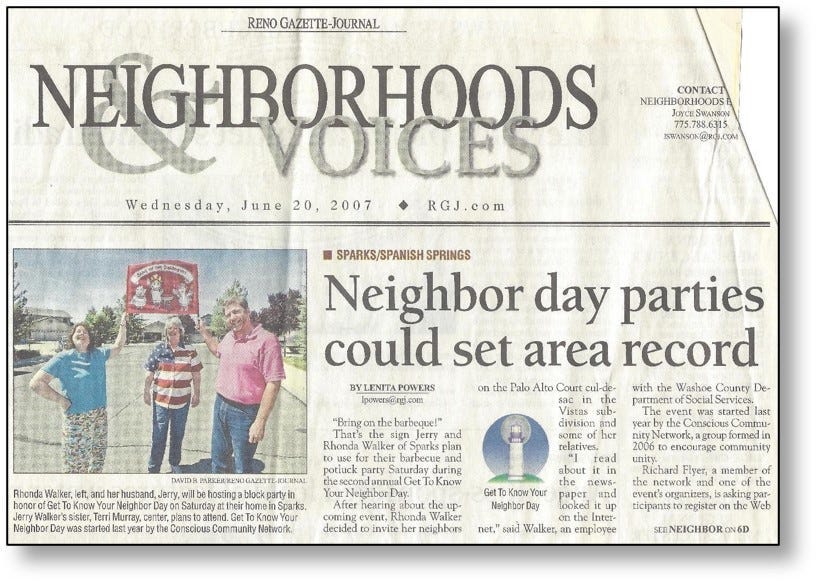
We weren’t beginning with an issue or cause. We were beginning with relationship.
Only later did I understand the significance of that distinction. After recognizing how often I had done the opposite in my own organizing, I began seeing the pattern everywhere.
I heard about two neighborhood efforts in the UK that initially sounded similar to Get to Know Your Neighbor. But one brought neighbors together around climate change and the other around conflicts with landlords.
Locally, in Reno, Nevada, a youth pastor friend told me his church would not participate unless they could use the neighborhood effort to preach the Gospel.
I began seeing the same pattern in regenerative and New Economy movements, nonreligious spiritual communities speaking of Oneness, Gaia consciousness, spiritual awakening, or higher consciousness, and political communities organized around their own visions of justice, freedom, or social change.
The language and visions differed, but the organizing logic was often remarkably similar: agreement came first, and belonging was organized around it.
Here the paradox:
If we only learned to build relationships with people who already agreed with us, we could never become a whole community.
Affinity could never be enough. A whole community had to be capable of holding people who disagreed profoundly, politically, culturally, religiously, and philosophically, without requiring them to become the same.
That’s when I realized that the answer couldn’t simply be another worldview, belief system, or social vision large enough to contain all the others, a kind of “One Ring to rule them all.”
Any worldview—even hopeful ones centered on Oneness, regeneration, or planetary consciousness—could become another boundary if agreement with it became the condition for belonging.
That’s how the Culture of Separation can co-opt the best intentions: a society of internally coherent but relationally disconnected worlds. Each could have its own beliefs, communities, and vision of the good, while the relationships between them remained largely untouched.
We could tolerate one another while remaining separate.
My experience in Northern Nevada revealed another possibility. The Love I had experienced kept calling me to bring what had become separated in the community back into relationship. But I was beginning to understand that I could not simply build connections between people and groups. I also had to recognize and heal the patterns of separation I carried within myself, my own assumptions and prejudices.
And through actual relationships, I began learning what it meant to build community with people whose beliefs, politics, cultures, and worldviews sometimes challenged my own.
A Christian pastor and a Pagan could disagree profoundly about God and still work together around local food. Conservatives and progressives did not have to settle the Iraq War before strengthening the local economy.
The breakthrough did not come because we pretended those differences were unimportant or simply set them aside. It came because we discovered that we did not have to agree first.
Belonging could come before agreement.
The life of the community itself gave us places to begin: food, children, livelihoods, neighborhoods, and other needs we shared. It echoed Dr. Ari’s simple wisdom: discover what we share in common and start there.
Perhaps this was the distinction I had been missing. A movement could gather people around shared issues, beliefs, or visions of change. But a whole community was different. It had to learn how to belong and act together even when we disagreed.
That realization opened a deeper question. If we belonged to one another before we agreed, what was the deeper ground of that belonging?
All You Need Is Love?
That question took me deeper. When people who saw the world differently crossed those boundaries and began to relate, serve, and build together, something new was clearly emerging between us.
Trust could grow where distrust had existed. People could begin seeing one another differently. Possibilities could emerge between us that none of us had brought into the relationship alone.
But were we creating the deepest coherence between us, or were we discovering and embodying something that was already there?
This deeper ground was not new to me. I had experienced what I called the Luminous Web throughout my life. Beneath the divisions and separations of the visible world, I had sensed an underlying sacred relational order in which difference did not erase relationship.
What I was beginning to see, or perhaps remember, was that the coherence I was experiencing between people might have a deeper ground. I began using the word Transcendent for that deeper Source, while recognizing that people understood its nature in profoundly different ways.
For me, the Transcendent points to a Source beyond creation whose fingerprints I see throughout the living world and whose presence I experience within it. I encounter that Source personally through Jesus Christ.
I did not have to surrender my conviction that Christ reveals ultimate reality. But neither did another person have to share that conviction before I could recognize that we already belonged to one another.
That became essential to how I understood the Ancient Blueprint. It could not become another belief system we all had to accept or a universal spirituality into which our different traditions had to fit. Our differences about the Transcendent could remain real without becoming barriers to our belonging.
In my experience, the deepest ground of our coherence was already there. It was what I had come to understand as Love as Structure. We already belonged to one another within that deeper relational order.
But that did not mean nothing new could emerge between us. Through our relationships, trust could deepen, new possibilities could appear, and new forms of cooperation could take shape.
I discovered that it is both. The deepest ground of our belonging could already be there, while something genuinely new emerged through the relationships we actually lived.
Not Love as another belief everyone must accept. Not Love merely as a feeling, a sentiment, or even a moral virtue. For me, Divine Love is something more fundamental: the sacred relational order in which we already belong to one another before we agree.
I have come to understand this deeper order as something we do not create. At our best, we discover it, remember it, and learn to participate in it.
But if Love was not simply another idea to agree upon, there was still something I needed to understand: How could Love become something we actually lived?
Love Must Be Lived
The Luminous Web had first come to me as an experience, not an idea. But that experience did not give me a theory of social change. I did not yet have the language of the Ancient Blueprint, Symbiotic Culture, or Love as Structure.
Much of the journey that followed was an attempt to understand how Love became something we actually lived, in our relationships, families, neighborhoods, and communities.
Looking back, I could see that the pattern I had begun to recognize in Jesus and the early Christian communities, Gandhi, Dr. Ari and Sarvodaya, and Havel and Benda’s Parallel Polis was also the pattern I had been living into through my own community work. In my own life, what I had experienced as the Luminous Web, and later as Divine Love through my encounter with Jesus, did not remain an interior spiritual experience.
I was beginning to understand Virtue as the bridge between Heaven and earth, the way Divine Love became embodied in us and shaped how we lived with one another.
Through the cultivation of Virtue, our inner lives could become more coherent even as our relationships and communities were being transformed. Personal and community transformation could unfold together.
The spiritual and the social were not separate worlds that somehow had to be joined together. They were dimensions of a single process: Divine Love becoming embodied in human beings and, through the way we lived and related to one another, taking form in the life of a community.
I had not begun with a theory about any of this. Love had first been something I experienced deeply. But experience alone was not enough. I had to do my best to live it.
I was beginning to understand that we could not overcome a Culture of Separation through its own logic. Simply bringing people together to cooperate and collaborate would not necessarily overcome the assumptions, prejudices, and patterns of separation we carried within us. We brought those patterns into the communities and structures we created.
If we wanted to build another way of life together, the inner and outer work had to unfold together.
Perhaps this was also part of what I had been missing in many of our approaches to social change. We could develop increasingly sophisticated theories, strategies, networks, movements, and visions of the future. We could gather with others who shared them and create communities of remarkable internal coherence.
But I had begun to question an assumption beneath much of this work: that if enough good movements, networks, communities, and initiatives developed in parallel, somehow they would eventually add up to a coherent new society.
Thousands of coherent movements do not necessarily create a coherent society.
The problem was not their differences. Their differentiation could be beautiful and necessary. Christian communities, regenerative communities, ecological movements, spiritual communities, justice movements, businesses, nonprofits, and neighborhood organizations could each cultivate their particular piece of the good.
We needed that diversity. But we also needed something else. This was the polarity I had been struggling to see.
We needed the beauty and integrity of differentiated communities, but we also needed coherence between them and across the larger community they shared.
Coherence within the parts did not automatically create coherence between the parts.
And that coherence between them could not come simply from adopting the same worldview, strategy, or organizing model. It had to be lived.
I began to see the same ancient pattern at another scale. What I had experienced inwardly had become something I had to live in relationship with others. Now I was beginning to see that the same was true across the life of a whole community. Its differentiated parts also had to come into meaningful relationship with one another.
The pieces did not have to become the same. Their differences did not have to disappear. Their integrity could remain. But the space between them could no longer remain untouched.
Love had to be lived there too, through relationships that could bridge different worldviews and grow into a larger relational architecture without agreement on a shared worldview.
And that left me with a much larger question: What would it look like for Divine Love to take social form?
Part 1: The Good Was Already There
Part 2: The Coherence Was Already There
Part 3: The Blueprint Was Already There
Part 4: When Divine Love Takes Social Form
Part 5: When Love Becomes Social Architecture
Part 6: When Love Becomes People Power
To learn more about the Book click HERE, or purchase below:

Thanks for this remarkable article. I understand and appreciate the linear and nonlinear way you approaches this topic and look forward to part four.
BTW: Have you heard about these studies?
https://ssir.org/articles/entry/the_relational_work_of_systems_change
https://ssir.org/articles/entry/healing-trauma-systems
I have personal interest in the inner transformational work and how it relates to collective healing and systems change.
👏