

Part 1: The Good Was Already There
Part 2: The Coherence Was Already There
Part 3: The Blueprint Was Already There
Part 4: When Divine Love Takes Social Form
Part 5: When Love Becomes Social Architecture
PART FOUR — When Divine Love Takes Social Form
When we participate in the Ancient Blueprint, something remarkable can happen.
Divine Love becomes embodied through Virtue.
Virtue shapes how we relate to one another.
Relationship finds expression in service.
Service strengthens community.
And communities begin building the relational, economic, and civic structures through which another way of life can take form.
The Parallel Polis: Building Another Social Reality
The good was already there. The islands of coherence were already in place.
But how could the Love within these functional networks come alive between them, drawing them into a larger whole? That question began to open up a different pathway for social change, beyond the familiar approaches I had seen in my own life and work.
The system is broken, so reform it. Or the system is broken, so leave it and build an alternative.
I had come to recognize that both kept us trapped within the same way of thinking.
Over the years, I had become increasingly skeptical that reforming existing systems could address the deeper problem. Political victories could change laws and institutions without necessarily changing the relationships, values, and culture beneath them. Too often, the struggle became about who could gain enough power to impose their version of change. Lasting change had to begin somewhere deeper.
On the other hand, building alternatives raised another problem.
As I was writing my book, I came into contact with hundreds of movements and organizations working for social change: regenerative and ecological movements, new-economy initiatives, Christian movements, intentional and spiritual communities, and many others.
But I began to see a familiar pattern. They often started with an alternative vision and drew people who already agreed with it. Regenerative networks attracted people committed to regeneration, new-economy initiatives gathered around a shared economic vision, and intentional communities around a particular way of life.
Once again, agreement came before belonging.
Often, the alternative was also defined by what it was trying to leave behind. I encountered this directly in responses to my own work. One of my Substack readers wrote to me, “Richard, I love your vision, but the West and capitalism are evil, and we need to move beyond them, not cooperate with them.”
I understood the impulse because I had once shared some of it. In the 1980s, I participated in civil disobedience in San Diego against first-strike nuclear weapons while also working with movements seeking to build alternatives.
During those years, I was also doing community organizing in one of San Diego’s high-poverty, multiethnic inner-city communities. I was part of a coalition that included progressive and even communist organizations. I’m ashamed to say that I sometimes referred dismissively to people outside our activist circles as “normies”—ordinary families raising children, going to work, attending the PTA at their neighborhood school, people who, in my eyes, simply didn’t get it.
Over time, the contradiction became harder for me to miss.
We wanted to transform society, yet the way we saw the world could separate us from many of the very people who made up that society.
Gandhi had understood something that took me much longer to appreciate. Speaking to India’s political leaders, he insisted that they could not truly represent India until they stood in the fields alongside the millions who worked there.
I came to understand his point in my own way. We could not transform a community from within our own political or ideological world. We had to enter into the everyday life of the community itself.
This was the possibility I would later recognize in the idea of the Parallel Polis: building another social reality from within the community, alongside the existing social order.
Decades of working in the everyday life of communities had taught me what that could look like. I ran nonprofits and businesses and worked with government agencies, churches, activists, business owners, neighborhood leaders, and ordinary people. The “system” was not something abstract outside the community. It was woven into the community itself.
That raised a practical question: how could we possibly build another culture and economy without being in relationship with the people and institutions that already made up the community? After all, we would still live alongside businesses, workers, nonprofits, governments, churches, and institutions that did not share our vision.
But the problem did not stop there. It appeared at the level of movements themselves. Thousands of movements were working in parallel, each building its own piece of a better world and attracting people who shared its vision. But what would connect them? Was the theory of change simply that each would keep growing until enough people joined?
And what about everyone else?
We could create something beautiful among people who shared our vision while remaining disconnected from the larger community we hoped to transform.
The very movements seeking another social reality could become islands themselves.
Connecting the Good That Is Already Alive
Yet when I looked back at my own community work, I realized I had been living a different answer for decades, calling it different things along the way: Conscious Community, re-villaging, and the Community Ark.
I had been helping that other social reality take root in the midst of the community itself. I was building relationships across the differences that had divided us, among businesses, nonprofits, faith communities, civic institutions, movements, and ordinary people.
The whole community itself was the container.
People did not have to share the same worldview. They already shared something more fundamental: a community and a life together. We could build another social reality together without having to see the world the same way: relationship first, not agreement.
When I encountered the idea of the Parallel Polis, I finally had language for something I had been trying to build for years. And it was not new. Others had discovered and lived this same pattern in different ways throughout history.
“Parallel” did not mean separate.
We could build another social reality without capturing the existing system or withdrawing into a world composed primarily of those who already agreed.
The same pattern appeared in the early Christian communities. Jesus did not organize his followers to capture Caesar and use political power to create a more moral society. Nor did he appeal to Caesar to reform the system. He began somewhere deeper. He proclaimed the Kingdom of God, a reality that could never be reduced to a new social order. Yet the lives of his followers were transformed by it.
They began living, loving, serving, sharing, and caring for one another in a different way. They lived within the dominant culture while another way of life was taking root among them.
And the Love they practiced did not stop at the boundaries of their own community. Centuries later, even the pagan emperor Julian would lament that Christians cared not only for their own poor but for Rome’s as well.
The Parallel Polis did not need to become another movement. It could take form as relationships grew across the movements, organizations, institutions, and people already rooted in a community. Over time, those relationships could weave the threads into a “whole cloth” community network.
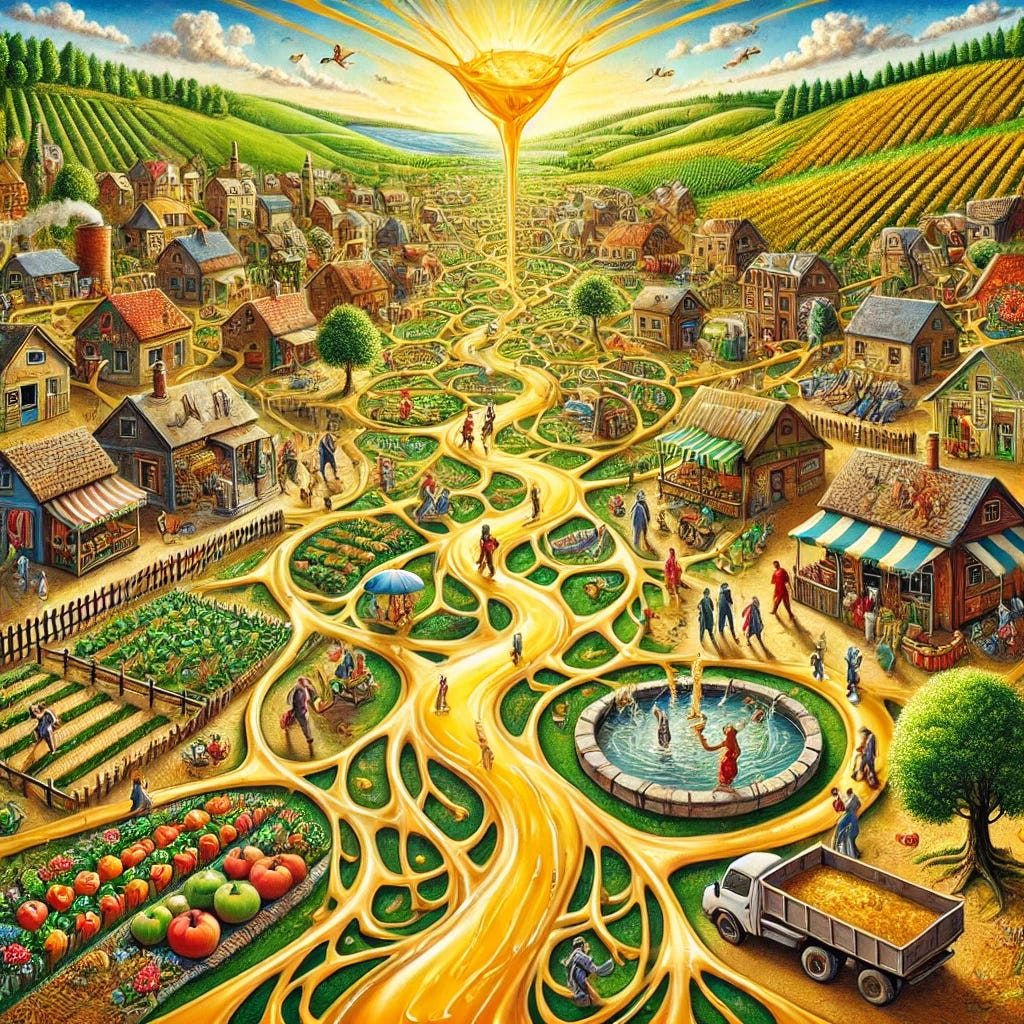
Something like this could not simply be legislated into existence. It had to be practiced into being.
And we weren’t starting from nothing. Billions of people around the world were already participating in movements, organizations, networks, faith communities, nonprofits, businesses, regenerative projects, and civic initiatives doing extraordinary work. The good was already alive on an enormous scale.
The problem, as I had learned again and again, was not that the good was absent.
The good was fragmented.
The challenge was not simply to do more good within a Culture of Separation, but to connect and multiply the good already present throughout the community.
That required a different relational context: a Culture of Connection.
No single movement can regenerate society in isolation. Each carries a piece of the good, but no single piece can become the whole.
Nor did the pieces have to become the same in order to become part of a larger whole. A neighborhood could remain a neighborhood. A church could remain a church. A secular organization did not have to adopt my Christian language. A food network could remain a food network. Each could retain its own identity while entering into deeper relationship with the others.
Each could begin where it was.
What If It Could Begin Everywhere at Once?
That possibility may matter more now than ever. The empires confronted by Jesus, Gandhi, Ari, Havel, and Benda were immense, but today many of the systems shaping human life operate at a scale that is truly planetary.
Yet this raised a question that had followed me through decades of community building: if transformation had to take root in the actual life of communities, how could anything we did as individuals and families living in one place possibly matter at the scale of the world?
I heard one answer from movements working for systemic change: our problems had become global, so we needed movements powerful enough to transform the systems producing them. From another direction came the opposite answer: change yourself, love your neighbor, serve the people around you, and somehow the larger world will change.
Both held part of the answer, but something was missing between them. How did transformation in individuals, families, and relationships actually grow throughout communities and outward into regional, national, and global structures?
What was missing was a relational architecture that could connect the two. From person to planet.
For years, I assumed that systemic change required larger movements, broader campaigns, and greater coordination. But my experience building local food, local economy, and neighbor networks was showing me something different. Did reaching greater scale necessarily require building larger, centralized, or global organizations?
Most movements and organizations grew by bringing more people into their cause, network, or way of seeing the world. To reach more people, the movement itself had to keep growing.
But what if we had the architecture backward? What if change could spread without having to replicate the same organization, movement, or network from place to place?
What if we didn’t have to solve global problems globally? What if transformation could begin locally, in communities everywhere, yet still spread far enough and fast enough to meet the crises we face?
Perhaps my training as a biologist helped me see this differently. Nature is filled with patterns nested within larger patterns, each part belonging to a larger whole. And as my relationship with God deepened, I came to recognize in creation something deeper: an underlying relational order rooted in Divine Love.
In Jesus’s simple teaching to Love God and Love Others, I recognized that same relational order: relationship to the Divine flowing into relationship with one another.
But if human beings were part of creation too, had that deeper relational order really disappeared from human society? Or had the Culture of Separation simply made it harder for us to see?
Nature offered another clue.
Think of a head of Romanesco broccoli. Break off a smaller branch and you see the same basic pattern. Zoom in or zoom out, and the pattern repeats. That’s a fractal.

I recognized something similar in our local food system network. It had begun one-to-one, with trust between people. Trusted relationships formed small circles, and circles connected into networks. As the network grew, not everyone knew everyone anymore, yet the same qualities of trust, respect, service, and cooperation could take form at a larger scale.
I saw it happening among restaurant owners who had once viewed one another primarily as competitors. They began cooperating, sharing knowledge and resources. As farm-to-table efforts expanded, a larger local marketplace began to emerge in which restaurants, farmers, and other businesses could thrive together.
And we didn’t need a formal organization to hold it all together. A few people could begin where they were, building trust and connecting those already doing the work, and the network could extend outward from there.
Over time, however, I discovered a limitation. Simply replacing organizations with networks was not enough.
A network could still become another silo, gathering people around the same issue, identity, or worldview while remaining disconnected from the rest of the community.
Only later did I understand why.
The network wasn’t creating the Love, trust, and goodwill flowing through it. If the Ancient Blueprint was a sacred relational pattern woven into creation and rooted in Divine Love, then it was already present within human society as well. The good was already there. But the Culture of Separation had fragmented its social expression, leaving that good scattered into islands.
What we were creating was a relational container in which the Love already alive within people, groups, and organizations could come alive between them, drawing them into a larger whole.
And that changed how I understood scale.
The pattern could spread without having to replicate the same organization, movement, or network from place to place.
Like mycelium extending through a forest, it could grow through connection: people forming circles, circles connecting with other circles, each becoming part of something larger.
Instead of asking people to join one movement or adopt one vision, we could invite them to connect the good already present where they lived. But could the same pattern take root across many communities at once?
I had first encountered Sarvodaya in 1991, and in my visit to Sarvodaya villages in 2022, I began to understand more deeply how far this pattern could extend.
I stood alongside people whose lives were rooted in immediate concerns: family, livelihood, food, health, and the needs of their village. Yet they understood these ordinary acts of community life as part of something much larger: the awakening of their village, their nation, and ultimately the world.
Standing in those villages, I recognized something I had not fully understood before.
Like many Westerners, I had tended to think of personal and systemic transformation as two different kinds of change. Dr. Ari did not separate them in that way. He understood the transformation of the whole community as a process in which the different dimensions of life could be brought into harmony.
The person did not have to become an insignificant cog in the wheel for transformation to reach a global scale. Nor did the village have to become a chapter of some standardized organization.
Sarvodaya connected people around community needs, villages with other villages, and communities into a movement reaching across the nation. Here was a different way of thinking about scale. Communities could begin where they were, tend their own roots, and allow the same pattern of Love to ripple outward.
I began to imagine tens of thousands of communities around the world, each connecting the good already present within it. They would not have to become chapters of one organization, followers of one leader, adherents of one theology, or participants in a centrally controlled global movement.
And then I realized that, on a much smaller scale, I had already seen this pattern taking shape. The farmers, neighbors, churches, businesses, nonprofits, and community groups I had encountered over the years were each already carrying a piece of the good.
Yet tens of thousands of communities can still sound impossibly large. My experience has taught me to start much smaller.
I had watched our networks grow from a single relationship into a small circle of trusted leaders. As those leaders reached into their own relationships, one circle could become two. At first, I saw this simply as a faster way for change to spread. I was accustomed to linear growth: one became two, two became three, three became four. Exponential growth was much faster: one became two, two became four, four became eight.
And then it struck me: if the same relational pattern could grow organically within each community, it could take root in communities everywhere at the same time.
Starting locally didn’t mean we had to settle for changing the world slowly.
Making Room for the Whole
But wherever change took root, it often began with one person willing to make room for the whole community—not because they had the answer, but because they were willing to listen, gather people, build relationships, and connect what was already alive.
The people and the good they carried were already there. My role was not to create what was missing, but to hold the space where they could find one another. And that required something of me as well: as best I could, I had to get my own ego out of the way.
Part of that meant recognizing that I hadn’t done it all myself.
I remember someone asking me, “How did you create that local food system in Northern Nevada?” My answer was simple: I didn’t. The farmers, restaurant owners, food advocates, and others who cared about our local food system were already there. I helped bring them together so they could find one another, build relationships, and begin collaborating.
The work could start very simply. Sometimes it meant picking up the phone and calling one person. One relationship led to another. But over time, I learned that connecting people was only part of the work. What we gathered around—and the kind of space we created when we came together—mattered just as much.
I had encountered this challenge several years earlier while we were building our Local Living Economy Network. It was 2003, and the country was deeply divided over the Iraq War. People were choosing sides: pro-war or anti-war. I began wondering whether there was another place where we could meet.
I asked a different question: What do we all care about—left and right, religious and secular, activist and entrepreneur? One answer was surprisingly simple: the health of our locally owned businesses and the community they sustained.
We weren’t pro-war or anti-war. We were Pro-Local.
That didn’t mean our political differences disappeared. They simply no longer defined the room. Democrats and Republicans, activists and business owners, people of faith and no faith could work together around a shared commitment to strengthening the local economy.
We had found common ground on which we could act together.
But as the network grew, I discovered that common ground was not enough. We also had to protect the space we were creating together.
I remember one meeting attended by more than a hundred business and nonprofit leaders. At the end, a man stood up and invited everyone to join him outside the Reno Convention Center to protest President George W. Bush, who was campaigning for reelection.
As the facilitator, I had a choice. I could let the comment pass. But if I did, Republicans in the room might reasonably conclude that beneath our shared commitment to the local community, this was really a progressive political space after all.
Whatever my own feelings about Bush or the war, they weren’t what had brought us into the room. My political opinions had not disappeared, but they could not define the space we were creating. Something larger mattered now.
Years later, I came to think of this kind of space as a cathedral:
“If we are to hold sacred space for others, we must first remove our shoes—our egos, fears, and ideological armor—before stepping into the ‘cathedral’ of community.”

Taking off our shoes did not mean erasing our beliefs, identities, or differences. It meant setting aside our assumptions and judgments so we could encounter one another within a larger shared space, without requiring our particular worldview to define the room.
That day, I thanked the man for his passion and for caring enough to speak up. Then I reminded everyone that we weren’t gathered to support or oppose George Bush, Democrats, or Republicans. We were there to strengthen our local economy together. I wasn’t asking him to give up his political convictions, or the Republicans in the room to surrender theirs.
They didn’t have to agree politically in order to belong.
But that applied to me too. If I wanted to bring people together across those divisions, I couldn’t allow my own perspective to quietly become the perspective of the room. Holding this larger space required something of me as well. I had to learn when to take off my own shoes.
I had first encountered Sarvodaya years before this work began. With time, I recognized how closely what was emerging in Northern Nevada echoed the pattern I had first encountered there: people coming together around shared community needs, with Love taking practical form through service.
Farmers, business owners, environmentalists, government officials, Christians, progressives, and conservatives could bring their differences with them. We were coming together to serve the needs the community already shared.
Only later did I understand the architecture beneath what we were doing.
Shared purpose gave us common ground.
Virtues shaped how we related within it.
Common community needs gave us places to serve together.
The pattern came alive through people gathering in small circles, building relationships, and acting together.
And a network-centered structure allowed people and organizations to retain their autonomy while becoming part of something larger.
These would eventually become elements of what I called Symbiotic Culture DNA.
But something more fundamental was happening. Belonging did not have to begin with agreement. Conventional movements often gather people who already agree. The Ancient Blueprint begins somewhere deeper, with a coherence that is already there.
We already share our humanity, inhabit communities together, and depend upon one another. Our common needs do not create that deeper coherence.
They give us places where Divine Love can take practical form together.
When Love Becomes Embodied
Much of what I had been doing was intuitive. I listened, learned from what happened, and adjusted as I went. In many ways, I lived into the work before I had language for it.
My time with Dr. Ari in Sri Lanka helped me see more clearly what had been happening beneath the work.
I remember sitting with him after lunch in 2022. By then I had seen what Sarvodaya had become: thousands of village communities and millions of people participating in a movement that joined spiritual awakening with the practical work of building another social reality.
I asked Ari a question that had been on my mind for years:
How could one person mobilize millions of people to build a new social reality? How had something that began with one schoolteacher and one village grown into a movement reaching across an entire nation?
Ari smiled but said nothing. And somehow, in that silence, an answer began to emerge.
The word that came to me was spaciousness.
There seemed to be so little in him that needed to occupy the space. He wasn’t seeking recognition, status, control, money, or political influence. He wasn’t trying to tell people what to do or convert them to his particular religious worldview. He was simply present and open to the people and community before him.
But his spaciousness was not an emptiness.
Something was present.
Love.
As I sat with what I was seeing in Ari, my Christian faith gave me another way of understanding it. In Jesus, I had encountered a Love that was radically self-giving. Divine Love was not simply something Jesus commanded us to give to others. It was something we first received.
As the First Letter of John puts it simply, “We love because he first loved us.”
I had experienced that Divine Love myself as something coming from beyond me, entering my life as a gift and changing how I saw the person before me. As I learned to receive it, my orientation toward others began to change.
Instead of beginning with what I wanted from them—agreement, recognition, influence, conversion, even participation in my own vision—I could begin with a desire for genuine communion.
A self-serving orientation could begin to give way to self-giving Love.
And now I could see what that looked like in Ari. His Buddhist language and spiritual tradition were different from mine, but I could feel the same self-giving orientation in the way he lived. For Ari, inner awakening and the transformation of the community were not separate realms of life. The spiritual took practical form in how he entered a village, listened, served, related to people, and made room for others to discover their own capacity to act.
Seeing this, the question I had asked him began to look different.
Perhaps the question was not how Ari had mobilized millions of people at all. In the same way that I had not “built” the local food system, Ari had not built Sarvodaya by himself.
He had become, as I came to understand it, a living expression of Divine Love. He made room for that Love to move through him into relationships where others discovered their own capacity to serve and act. As they did, that Love could flow outward far beyond any one person.
I was beginning to recognize something fractal in the way this happened. The pattern was not simply expanding; it was taking root in the lives and relationships of others. People who discovered their own capacity to serve could build relationships, gather others, and act together around the needs of their communities. From person to person and community to community, the movement could grow and replicate without depending on any one person to direct it.
But Love did not move outward by itself. It found pathways through the relationships people formed with one another.
As people came together around shared community needs, relationships became circles, circles connected into networks, and people began creating social and economic structures through which that Love could flow and take practical form.
As these connections multiplied, a living relational infrastructure began to emerge. Love was becoming embodied not only in people, but in the relationships and structures they created together. And as those relationships extended across different dimensions of community life, the possibility of something larger began to appear.
I came to see that the deeper coherence of Love was already there, preceding the movement and its structures. They had grown as people gave that Love relational and social form. Here was the Ancient Blueprint coming alive.
Looking at Ari, I could finally see more clearly what holding space required. It was not simply a way of bringing people together. It began with making room within ourselves for Love, so we could make room for it between us.
From Holding Space to People Power
But holding space could not depend on one person. If we hoped to build communities capable of coming together across their differences, more of us had to learn to become uniters rather than dividers.
That was not simply a matter of learning a new facilitation technique. It required something of us inwardly.
At times I felt as though I were standing in the eye of a hurricane. Around me were people with different beliefs, politics, interests, personalities, and histories. And the more I tried to hold space for all of them, the more that space revealed what was happening within me.
This was some of the hardest inner work I had ever done. The differences between us exposed the places in me where I was still judging, separating, or withholding Love. The more tightly I held to my own need to be right, the less room there was for others. The more I could release those judgments, the more space there was for relationship.
I could not create a Culture of Connection in the room while carrying the Culture of Separation within my own heart.
For me, becoming a uniter often meant returning to prayer, opening myself to God, and remembering my intention to hold a space large enough for the people before me.
I came to think of this as an “extended spiritual practice.” I did not have to leave my Christian faith behind when I entered the wider community, nor did anyone else have to give up theirs. Instead, the community itself could become another place where we practiced Love in action, learning to live the Virtues alongside people who did not necessarily share our beliefs.
Spiritual development and community transformation no longer had to remain separate from one another.
I began to understand more personally what Sarvodaya meant by its simple saying, “We build the road, and the road builds us.” Entering into relationship and serving together could itself become part of how we were transformed.
One example came to be known among us as the story of the “Pastor and the Pagan.” A neo-pagan farming teacher and an evangelical Christian pastor came from very different spiritual worlds, yet in the space we had created they discovered a shared passion for regenerative agriculture.
They did not need an interfaith dialogue or agreement about their beliefs before they could begin building a relationship. They needed a trusted space where they could encounter one another around something they both cared about.
In our Connections Gatherings, small circles we had developed, we practiced this movement from Head to Heart to Hands. We reflected on the Virtues, then brought actual needs, relationships, and opportunities for service into the circle.
Holding space became a spiritual and relational practice we could participate in together. As I wrote in the book, “Grace opened the space. Love built the bridge. And truth walked across it.”
The coherence that made relationship possible was not something I created between us. It was already there, something each of us could receive and participate in. My role was not to be the expert, have the answer, or become the savior of the community. I was learning to become a steward of the space between us.
But if this work was going to extend beyond me, I could not remain the one holding the space. Others had to discover that capacity in themselves.
The fractal pattern was becoming clearer.
The qualities we hoped to see embodied in the whole had to become embodied in its smallest living parts—in ourselves, our relationships, and the spaces we created together.
I had already watched this happen in our own networks.
When I began reaching out to people in our local food system, I did it one relationship at a time. I would begin with someone I trusted, listen to what they cared about, and then follow the connections that opened from there. Gradually, those one-to-one connections became a small circle held together by trust.
What began with one person holding space could become a circle of five capable of holding that same quality of space together. As that small circle reached into its own trusted relationships, something important began to happen. Five could become ten, and one circle could become two, each carrying the same relational character as the first.
The network was no longer dependent on me to make every connection. Others could carry the same relational qualities into relationships of their own.
This was the fractal multiplication I was beginning to recognize: the network could grow without requiring one person or one circle to hold the whole.
The capacity to hold the space was becoming distributed.
What began in a conversation with one farmer expanded into a small circle of committed leaders, then outward through their trusted relationships, until nearly a hundred regional leaders came together at our first large public gathering.
Those leaders, in turn, represented organizations, businesses, institutions, and constituencies reaching more than a hundred thousand people across the region. Yet as the network grew, we did not have to lose the relational quality with which we had begun.
The network could grow because the quality of relationship itself was being carried outward.
And that helped me understand how this pattern could move beyond any one person or region. As more of us learn to become uniters where we already stand, each of us can become a new point of connection.
Imagine one person becoming a uniter in a neighborhood. Another in a church. Another among farmers, business owners, activists, or civic leaders. Each begins connecting people across the boundaries around them, creating relationship where there had been separation. No one needs to control the whole. Each helps carry the relational pattern outward.
And as that capacity spreads, leadership spreads with it. People can rediscover their ability to relate, serve, cooperate, meet needs, and build together without waiting for someone above them to organize their lives.
What I had witnessed in Sarvodaya villages in Sri Lanka was now taking form in the very different context of Reno. People were beginning to shape more of their common local life together.
This was a different kind of people power.
It did not begin by mobilizing one group against another or joining the battles of party politics over who would prevail. It began by creating spaces where people could come together across their differences without allowing those differences to define their relationships.
The more I experienced this, the more I understood what we were holding space for.
The Culture of Separation was all around us, pulling us into opposing camps of politics, religion, economics, ethnicity, and identity. These divisions could become so powerful that we lost sight of what united us.
Holding space meant refusing to let those divisions determine how we saw one another. Beneath them, the deeper coherence of the Ancient Blueprint was still there. Our shared humanity was still there. Our common needs were still there. Divine Love was still there.
We were holding space for a Culture of Connection to take root within the Culture of Separation itself.
But what becomes possible when that Culture of Connection extends beyond individual networks and begins taking shape across an entire community? Next, in the final Part 5.
Why Coherence Must Precede Our Strategies for Social Change
Part 1: The Good Was Already There
Part 2: The Coherence Was Already There
Part 3: The Blueprint Was Already There
Part 4: When Divine Love Takes Social Form
Part 5: When Love Becomes Social Architecture
To learn more about the Book click HERE, or purchase below:

Putting relationships first is so important, not just for community building but for our personal lives too.
When we treat each other with respect and learn from different viewpoints, we're enriched, and become more well-rounded human beings. And that is secondary to having close, trusting relationships, which are foundational to everyone's happiness.