

Part 1: The Good Was Already There
Part 2: The Coherence Was Already There
Part 3: The Blueprint Was Already There
Part 4: When Divine Love Takes Social Form
Part 5: When Love Becomes Social Architecture
Part 6: When Love Becomes People Power
PART TWO: The Coherence Was Already There
Introduction
But connecting people still left me with a deeper question. If relationships, trust, and cooperation could not simply be engineered into existence, where did the coherence that made them possible come from?
Only much later did I understand that community work had become the place where I was testing, often without realizing it, a deeper coherence I had experienced long before. What began as a personal spiritual question would eventually lead me toward something much larger: a pattern I began to recognize across communities, cultures, and generations.
But to understand how I came to see it, I first have to return to experiences that began decades before I brought community together.
The Spiritual Source of Coherence
Long before I knew anything about networks, nonprofits, local economies, or community organizing, I had experienced something I could barely explain. Beginning when I was twelve, I had a series of non-ordinary spiritual experiences that continued for years.
In those moments, the ordinary boundaries of life seemed to disappear. The world no longer felt divided into separate things. Nature, other people, and my own awareness seemed held within a single living and loving Presence.
I felt connected to everything and, at the same time, part of something
infinitely larger than myself.
I hadn’t thought my way to this understanding. I experienced a mysterious luminosity that felt more fundamental than the separateness of everyday life. I came to think of this as a Luminous Web.
Yet this Presence was anything but abstract. It was intimate and relational, as though what I was encountering somehow knew me. I felt I was touching an Ultimate Reality larger than anything I could comprehend, yet profoundly personal.
I had no name for it, but over time it gave me something I had never known before: an underlying trust that I belonged to something larger than myself, that beneath everything, I was held in unconditional Love. For years I followed that thread without knowing where it would lead.
Then, in 1990, during a nighttime drive through rural Baja California, the experience became unmistakably personal. As we passed small homes illuminated by kerosene lamps, my heart opened with overwhelming compassion for humanity.
I experienced what I understood to be an encounter with Jesus.
My perspective shifted until I seemed to see the planet from above. Instead of city lights, I saw golden rays rising from the hearts of billions of people, converging into a great radiant Heart. It pulsed with a Love so complete that, for a moment, all boundaries disappeared.
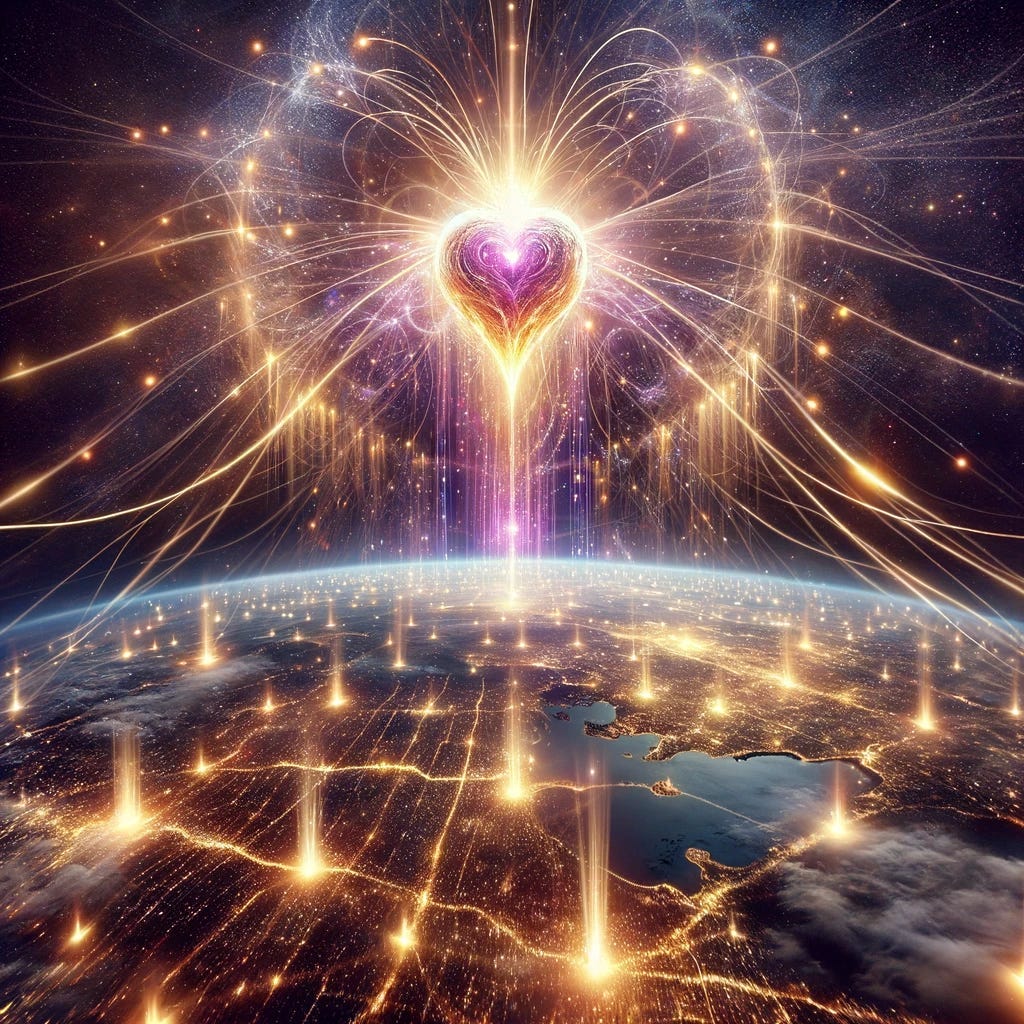
Then the light began to flow back toward Earth, entering each person and moving from person to person, community to community, until a new web of Love and Light spread across the planet.
What I had experienced for years as the Luminous Web now had a face. Divine Love was pouring into the world through Christ. And in Jesus I began to see something else I had been searching for without knowing how to name it:
the inseparability of loving God and loving one another. The transformation of our hearts and the transformation of our life together were not two different things.
I didn’t emerge from this wanting to start a new religion. I emerged with a question that would follow me for decades: if this unity and Love were real, why did human society seem so fragmented and broken?
My heart felt so open that I seemed to take in the world's suffering. The distance between the Love I had just experienced and the world as it was broke my heart.
Jesus’ simple teaching, Love God and Love Others, gradually began to look less like moral advice and more like a description of reality itself. I had experienced Love moving in a pattern: received from beyond ourselves, flowing through us, and connecting us to one another.
I eventually came to call that pattern the Ancient Blueprint: a sacred relational order woven into creation through which Divine Love becomes livable.
Divine Love orders relationship toward flourishing; coherence is our alignment with that pattern. To receive that Love is to be drawn into communion with others, allowing what begins within us to take form in relationship, service, and community.
Love as Structure
This is what I mean by coherence.
I do not mean uniformity, ideological agreement, or simply getting people to cooperate. Relationships alone do not guarantee flourishing; they can nurture or control, liberate or wound. What I had experienced pointed toward something more radical and beautiful: Love as a structure.
The question was no longer simply whether we were connected, but what orders those relationships toward flourishing.
Gradually, I began to understand the contradiction that had broken my heart. The coherence I had experienced had not disappeared.
We had learned to live as though it were not there. A Culture of Separation had formed us, teaching us to see reality in fragments and dualities: spirit and matter, individual and community, religion and civic life, one organization and another, one movement and another.
Over time, experiences I had once kept in separate categories—faith, science, business, community, economics, and ecology—began to reveal a common relational pattern.
I came to understand its source as a reality larger than ourselves—what I call the Transcendent. Across cultures and traditions, people have sought to understand and relate to what lies beyond the self, giving that mystery different names and expressions.
For me, the Transcendent became personal through Jesus Christ. I am a Christian, and I understand Divine Love through him. But recognizing that does not require me to believe that everyone must share my understanding before we can love one another, serve together, or build community.
Yet others need not understand the Transcendent the same way I do. The invitation is not to merge our differences into a new spiritual synthesis, but to remain rooted in our deepest convictions while learning to recognize the good in one another and serve the life we share.
What began for me as an encounter with Divine Love had become a question of social transformation: how could that Love become embodied in the relationships, communities, and institutions around me?
Rather than asking only how we might design better systems, I began asking how systems and structures might grow from and embody this deeper coherence.
The Ancient Blueprint was no longer merely a spiritual insight; it became the starting point for a different approach to cultural transformation.
Virtues became the bridge from inner life to public life: Divine Love received inwardly and expressed in how we actually treat one another.
And this is where I believe many of our noblest efforts can still lose the thread.
Faith communities, social-change efforts, regenerative movements, purpose-driven businesses, and civic and cultural initiatives are already carrying pieces of a Culture of Connection. The question is not whether they are doing good. It is whether they can recognize one another as part of a larger relational pattern and connect across the boundaries that keep their good fragmented.
For me, the Christian Church presents this question in its most challenging form.
Christianity already carries the teaching at the center of my own journey: Love God and Love Others, the Kingdom of Heaven, the invitation to bring Heaven to Earth. Yet churches, like every human institution, can embody profound love within their own communities while remaining separate from the larger human family.
Consider the extraordinary scale of what is already on the ground. The Catholic Church alone encompasses more than 1.4 billion people worldwide and more than 300,000 local parish and mission communities. We often speak as though social transformation requires us to build entirely new networks to reach people.
Yet one of the largest place-based relational infrastructures on Earth already exists, embedded in cities, towns, villages, and neighborhoods.
The deeper question is what becomes possible when this immense relational infrastructure begins connecting the good within its communities to the good already present beyond them.
An island of coherence, after all, need not be small. It can be an enormous and highly developed network. What makes it an island is the relational boundary that keeps the life within it disconnected from the larger whole.
Discovering Coherence Across Difference
On Valentine’s Day in 2006, nearly one hundred community leaders gathered in Reno, Nevada, for an experiment we called Taking Love Higher.
They came from more than twenty religious and spiritual organizations, along with nonprofits, businesses, government, social activism, and other areas of civic life. They represented different political perspectives, beliefs, and institutions. We were not trying to reconcile those differences or create a new belief system. Nor was this simply an interfaith gathering—or to use a more contemporary term, an interspiritual one.
We were asking a more practical question:
What could unite us as a community, and how could we begin living and working from that shared ground?
The question had grown out of several years of community-building in Northern Nevada. We had already catalyzed a Local Living Economy Network and a Local Food System Network. We wondered whether the same symbiotic network approach could extend into other spheres of community life—neighborhoods, faith communities engaged in service, health, the environment, and more.
But something deeper was becoming clear. The greatest obstacle was not a shortage of organizations, programs, or good intentions. It was our inability to work together across the boundaries that separated us.
At the gathering, the participants themselves identified disunity as one of the central challenges facing the community. Rather than beginning with everything we disagreed about and trying to resolve our differences, we took a different approach.
We asked: What do we share in common?
Through that question, something remarkable began to emerge.
Looking back, I think we were also recovering something modern civic life had largely forgotten. In trying—often for good reason—to protect the public square from religious division and domination, we had stripped much of our shared civic language of anything that sounded spiritual or transcendent.
Religion and spirituality increasingly came to be regarded as matters of private life. But the space left behind did not remain empty. Materialism, consumerism, and individual self-interest increasingly shaped our common life, crowding out the deeper values and sources of meaning that people still carried within them.
This was not simply my impression. Years earlier, the Merck Family Fund’s Yearning for Balance study had found that 85 percent of Americans believed materialism, greed, and selfishness were crowding out deeper values. People wanted material security, but they did not want to lose their deeper human aspirations in the process.
Perhaps what we were experiencing in that room was part of that same yearning—a desire to recover a deeper ground for our common life without requiring us to share the same religious beliefs.
We were not trying to put religion back into the public square. We were discovering something more fundamental: the Transcendent did not belong exclusively to religion in the first place.
Beneath our very different worldviews was a surprisingly deep reservoir of common ground. We understood the Source of that common ground in different ways. For me, as a Christian, that Source is found in the person of Jesus Christ. Others spoke of Spirit, a Higher Power, the sacred, nature, or simply something larger than themselves.
But the important question for building community was not whether we believed the same thing. It was how our deepest convictions became embodied in the way we lived. Our different beliefs did not have to disappear for us to recognize Love, integrity, courage, service, and respect in one another. The common ground became visible through our actions.
As Jesus taught, “let your light shine before others,” so that others may see your good deeds. For me, this was how Divine Love moved from spiritual conviction into relationship and community—not by requiring others to share my beliefs, but through how I encountered and served them.
In a sense, we were remembering something we had forgotten: a community could acknowledge a dimension of life beyond individual self-interest without requiring everyone to believe the same thing about its Source.
That led to a practical question:
What qualities would we need to embody to build community together?
Through dialogue, research, and the community work that followed, we eventually identified five central Virtues: Love, Integrity, Courage, Service, and Respect, supported by roughly thirty-five related Virtues. We intentionally tested them to make sure they transcended religious language.
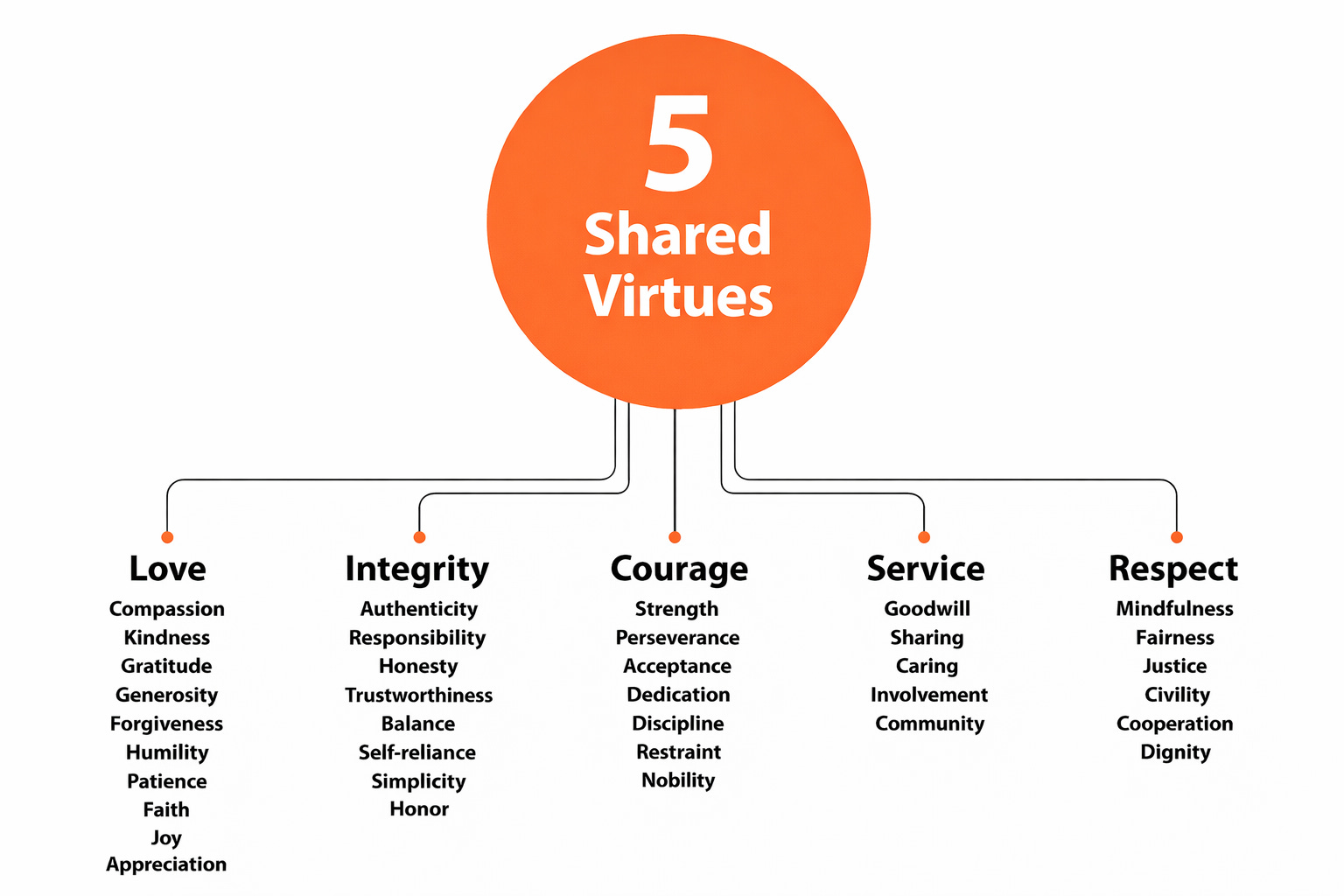
Could they also be recognized by government, business, nonprofits, civic organizations, and people who did not share a particular faith? Again and again, the answer was yes.
People can value very different things. But qualities such as integrity, courage, service, and respect seemed to reach beneath many of those differences. They gave us a common language not for what we had to believe, but for how we wanted to live together.
I eventually came to understand Virtues as a bridge between the Transcendent and everyday life—the way a higher reality becomes embodied in human character and relationship.
And that was only the beginning.
Through the community experiments that followed, a larger pattern gradually took shape: a shared purpose, common principles, Virtues, common community needs, and a network-centric way of connecting people and organizations already serving those needs. We developed circles and other relational structures through which these commitments could be practiced and carried into the wider community.
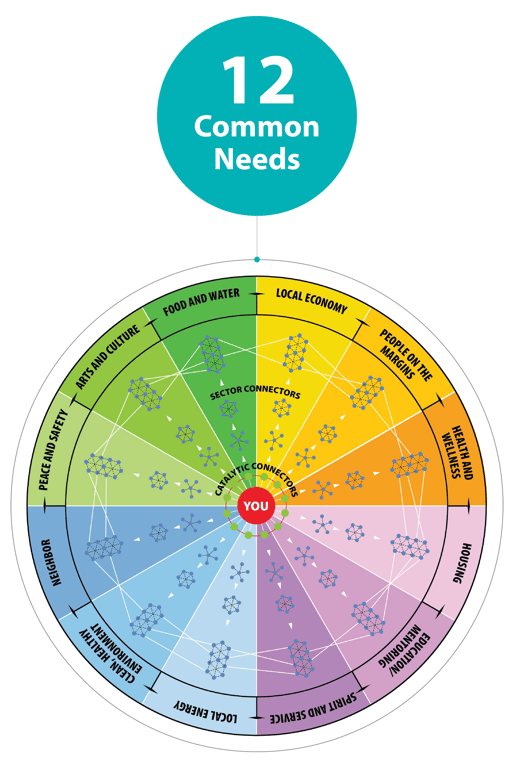
Years later, I would call this Symbiotic Culture DNA. We had not walked into that Valentine’s Day gathering with some ready-made design. It emerged gradually from our community’s collective intelligence as we tried to give form to what we were discovering together.
Looking back, I can see something I did not fully understand at the time: We didn’t create coherence by designing a system.
We discovered the coherence that was already there and then began designing structures that would allow it to take practical form.
Spiritual Coherence Precedes Systems Design
Years later, I encountered a striking confirmation of this pattern from a culture very different from my own.
In the fall of 2022, after my wife and I moved back to Hawai‘i, we attended a gathering of Indigenous elders and leaders from across Oceania focused largely on food systems and breadfruit. There I met Dr. Failautusi Avegalio Jr.—“Dr. Tusi”—a Samoan elder who had seen one of my videos about Symbiotic Networks.
He approached me and said that what I was describing reflected the Indigenous way of community he knew.
As Dr. Tusi explained it, the Polynesian approach to collaboration begins from a very different premise than much of modern organizational life: we are already connected.
In the Polynesian understanding he described, all people are kin, connected through a spiritual reality called “mana.”
In human relationships, that connection is expressed through faaaloalo—trust and mutual respect—and alofa—love. Collaboration therefore begins not by designing a structure or gathering people around a plan, but by cultivating relationship. A leader meets one-on-one with people, building trust and connection. Only then does the larger group come together, ready to collaborate.
I was stunned by the parallel.
Dr. Tusi and I had arrived at this understanding through very different cultural and spiritual paths. Yet the pattern he described was remarkably similar to what we had discovered in Reno.
A deeper connectedness becomes embodied through love and respect. Love and respect make relationship possible. Relationship builds trust. Trust enables cooperation. Cooperation facilitates coordination. And eventually structures emerge to carry what has already formed into the larger community.
That was when I began to wonder whether modern community-building had the sequence backward.
Much of contemporary social change begins with systems design. We create organizations, frameworks, programs, movements, networks, economic models, governance systems, and community-building methodologies. Then we bring people into them and hope relationship, trust, and a healthier culture will emerge.
I too had often assumed that if we could design the right networks and systems, a healthier culture would follow.
But my Reno experiences and my encounter with Dr. Tusi suggested another sequence:
Transcendent orientation → Virtue → relationship → trust → cooperation → coordination → systems and structures
The language we use for the Transcendent may differ. The sequence does not require us to share the same beliefs about it. What matters socially is that our deepest orientation becomes embodied in the qualities through which relationship and trust become possible.
Through my Christian understanding, I would describe the deepest movement this way: Divine Love becomes embodied in human character, expressed through Virtue, and lived in relationship—and through those relationships, begins to shape our common life.
This is what I mean when I say: Spiritual coherence precedes systems design.
This is not to say that systems design is unimportant, or that everyone must first become “spiritual,” much less adopt the same religion or worldview. It means that a system cannot manufacture the human qualities upon which a healthy system ultimately depends.
Love precedes organization. Organization cannot produce Love.
A beautifully designed institution populated by people who do not trust one another will eventually reflect that absence of trust. A network cannot manufacture relationship merely by connecting nodes. A governance structure cannot produce integrity through procedure alone. Even a supposed “new economy” cannot legislate generosity into the human heart.
But coherence does not eliminate the need for design. It changes the role of design.
Once people embody Virtue, build relationships, discover common needs, and learn to cooperate, design takes on a new, important role. Systems and structures can help coordinate that cooperation, sustain it over time, and amplify what people can accomplish together.
The structure does not generate the coherence. It becomes a vessel that gives coherence form, allowing it to endure and grow.
But another question remained. If this pattern was real—if coherence truly preceded the structures that carried it—was this simply something I had discovered through my own experience, or was I recognizing something much older?
Find out in PART 3 next week!
Part 1: The Good Was Already There
Part 2: The Coherence Was Already There
Part 3: The Blueprint Was Already There
Part 4: When Divine Love Takes Social Form
Part 5: When Love Becomes Social Architecture
Part 6: When Love Becomes People Power
To learn more about the Book click HERE, or purchase below:

as always in all wayssss, thankyou, richard, for sharing the purity of your divine heart! <3 and, i am wondering if you know of a community/group/individual/etc that is in the nevada city ca area? i am currently serving at ananda, and will be leaving here on our about sept 17. i love all that you share and find deep resonance in my own direct experience in my life up till now. i look forward to hearing from you at your earliest convenience <3
I'm not in the least bit religious, Richard, but I agree with you 100%. We need to put our relationships first, be respectful, and accept our differences, while working together for the kind of loving world we want to nurture.