

For generations, we have worked to build a better world by organizing movements around our different visions of what society should become. Whether through churches and faith communities, social-change organizations, regenerative and environmental movements, purpose-driven businesses, or civic-engagement initiatives, we follow the same organizing pattern.
We gather people who share our worldviews, build organizations and networks, and work to expand our influence. Yet the larger society remains as fragmented and polarized as ever. Here is the tragic paradox:
No movement can transform society on its own. Yet we continue to believe that if our movements grow large enough, they will eventually change society. But by organizing primarily with people who share our beliefs, we keep dividing the very society we are trying to transform.
This is the invisible logic I call the Culture of Separation.
After forty years of grassroots community organizing, I realize we have gotten social change backwards.
Instead of asking people to join our separate movements, we need to show up for the people and organizations already doing good throughout our communities. The goal is not to build one larger movement that brings everyone under a single vision. It is to connect the good already present throughout the whole community.
I saw the power of this approach firsthand in Northern Nevada, where I helped build a Local Living Economy Network and a Local Food System Network. When we brought conventional and regenerative farmers together with the rest of the local food system, regenerative practices spread beyond the people who already embraced them.
Here is the irony and the paradox: Whole-community building advances the work of individual movements more effectively than organizing exclusively within them.
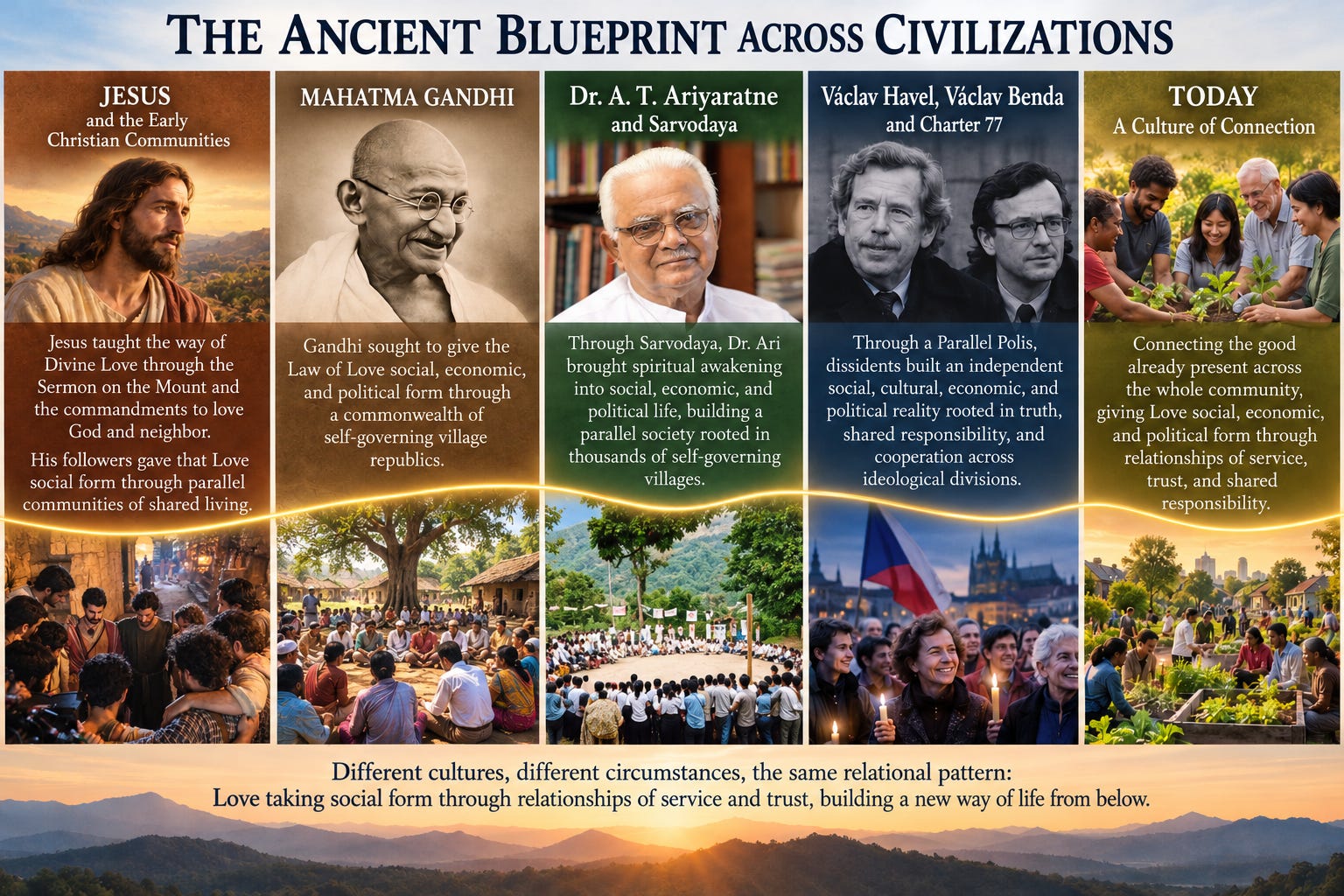
What I experienced locally was part of a much larger historical pattern, what I call the Ancient Blueprint. From Jesus and Gandhi to Sarvodaya, Charter 77, and Solidarity, I traced a history of people building new ways of living together across religious, political, economic, and cultural divisions. They brought different parts of society together without requiring everyone to share one vision of the future. Their strength came from connecting the good already present across these different parts of society.
That same extraordinary good is already present in communities throughout the world.
More than one hundred million organizations, community groups, and businesses already involve billions of people.
Through their everyday work and service, they are already laying the foundations for a whole-community revolution, whether or not they identify with a social-change movement.
Consider how much is already here:
Approximately 10 million formal nonprofits and an estimated 50 million grassroots associations and community groups.
4.4 million Christian congregations worldwide, alongside religious communities of other faiths.
Approximately 10 million social enterprises addressing social and environmental needs.
Across Europe and the US, an estimated 700,000–850,000 Christian congregations and more than 700 million Christians among 1.1 billion people.
Approximately 2.1 billion people volunteering monthly, mostly outside formal organizations.
Hundreds of millions of micro, small, and medium-sized businesses supporting livelihoods and local economies.
Within this larger world are movements working to change different parts of society. These movement threads include:
faith and spiritual communities
charities and social-change efforts
civic engagement and bridge-building movements
regenerative culture and creation-care movements
purpose-driven businesses
New Economy and commons movements
localization and bioregional networks
pro-democracy and civil-society movements
arts and cultural communities
These movements are already doing extraordinary good, each contributing its own vision of a better society, but they largely operate in isolation.
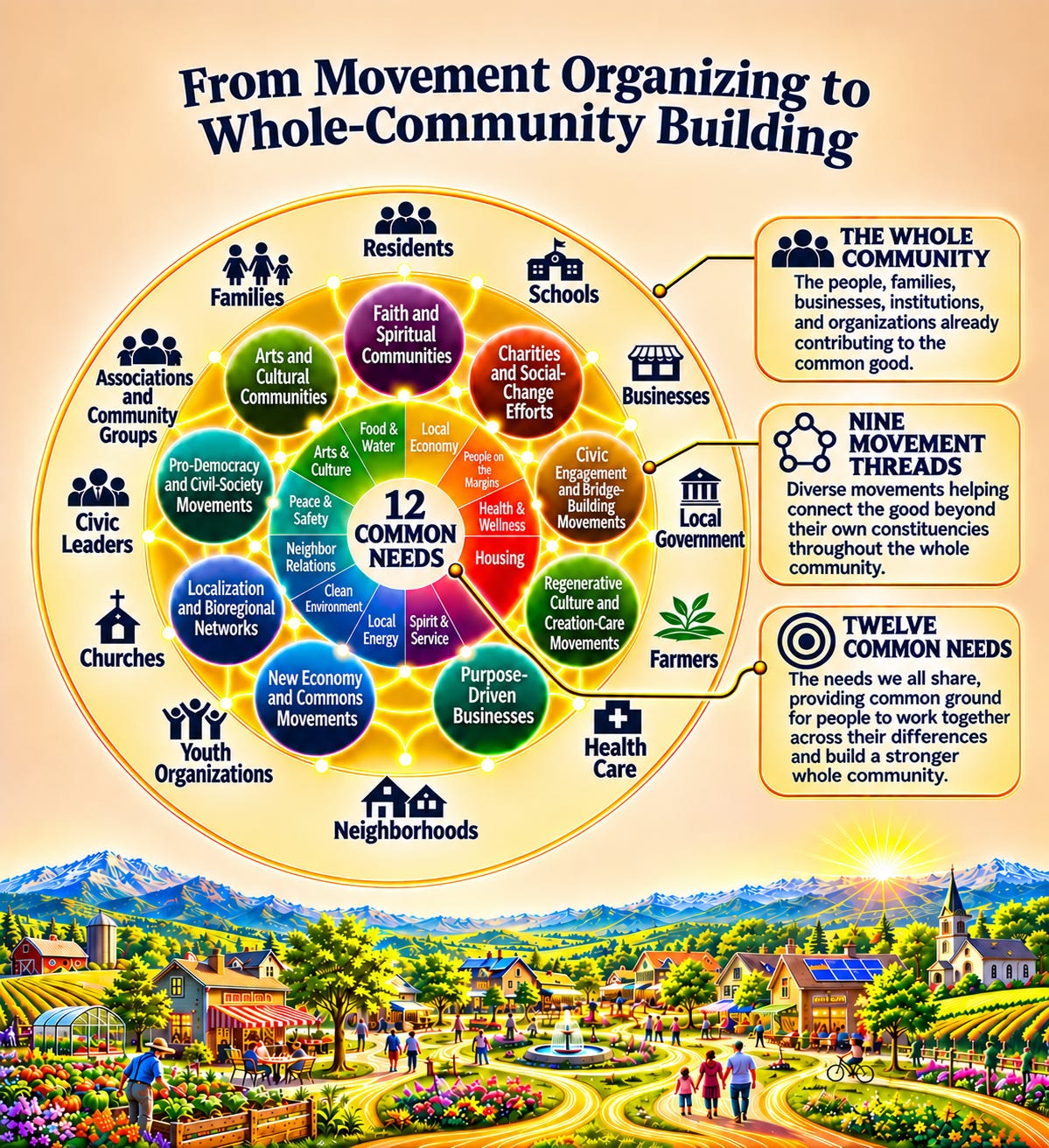
The alternative is to begin with the whole community, not with any one movement. That means starting with the people and institutions already there. The twelve Common Needs give us a place to start working together. They are not twelve more issues around which to build separate movements. The farmer, the restaurant owner, the pastor, the businessperson, the neighbor, and the community organizer do not need to share a worldview or join the same movement.
Instead, they work together to meet the needs they already share. In the process, they build relationships, trust, and the power to accomplish together what none could accomplish alone.
As people build on these relationships to create networks and institutions that serve their shared needs, a Whole-Community Parallel Polis begins to take shape. This parallel society grows as businesses, neighborhoods, faith communities, and civic organizations build lasting ways to work together. It does not require everyone to participate in everything or to agree about everything. Political power grows when people across those differences act together.
Building a parallel society does not mean separating from the rest of society. This is a Third Way, beyond trying to change the dominant system from within or withdrawing to build a separate alternative. Instead, we remain connected to our fellow citizens and draw upon what is already good in society, while building greater independence to meet our shared needs and make decisions about our common life.
The people who will build this future are already here: our neighbors, farmers, business owners, teachers, pastors, community organizers, and countless others contributing to the common good every day. They are already part of the society we seek to transform.
When we connect the good they are already doing, social, economic, and then political power grows from the bottom up, through the whole community rather than through the expansion of separate movements.
Love has political consequences without politics being where the process begins.
I’m sharing these reflections because I want to connect with others who are questioning how we approach social change and are ready to explore a different way.
If you’re working to build a better world, I’d welcome a personal conversation about how we put whole-community building into practice. I’d also welcome opportunities to bring this discussion to your networks. Please reach out. I’d love to hear what you’re discovering in your own work.
To read the whole essay:
We’ve Gotten Social Change Backwards
Or to read the new book:
Recovering the Sacred pattern of Common Life
Sounds like you are creating a system of connection to the commonality found in the unified field that runs through everything. Indigenous nations already knew this before mankind separated itself by perceived necessity.
I’m working with group transformation in the morphic field of separation patterns within human consciousness to weaken the need for division behaviors to be dominant.
It’s then easier to create underlying blueprints for uniting in a system of wholeness that evolves through common purpose.