

We’ve Gotten Social Change Backwards!
After forty years of grassroots community organizing, I’ve come to a startling realization:
We’ve gotten social change backwards. We build movements with people who share our worldviews yet end up reproducing the very Culture of Separation that divides the society we’re trying to change.
I’ve encountered this pattern in Christian churches and other religious or spiritual movements, regenerative economic and ecological movements, social justice movements, progressive and conservative political movements, business networks, and cultural movements. Their worldviews differ, but their organizing pattern is the same.
We welcome people who share our vision as potential members, volunteers, and collaborators. But we see those who don't as people to persuade, awaken, convert, recruit, compete with, or defeat. In doing so, we fail to recognize the good they are already contributing to the very society we're trying to transform.
The greatest challenge of our era is not simply war, poverty, ecological destruction, social injustice, economic inequality, polarization, or concentrated power, to name a few. Even as we organize to address these problems, we struggle with a deeply ingrained tendency to form tribes and organize ourselves into separate silos. We decide who belongs and who doesn’t, dividing ourselves from the very people with whom we need to work.
The answer is not to overcome our need to belong to groups. That’s part of human nature. Instead, we must learn to extend the trust, care, and belonging within our kinship groups to people with different worldviews. We do this without asking them to change their beliefs or identities.
I call this moving from Tribal Kinship to Symbiotic Kinship: consciously connecting people and groups across their differences to meet the shared needs of the whole community.
I found two universals that bring people together beyond shared worldviews or individual issues: Love and the twelve shared needs of every community. I came to recognize Love not merely as a feeling or moral sentiment, but as the underlying structure of reality itself. Holding space for an entire community was among the hardest things I’ve ever attempted. It forced me to confront my own judgments and prejudices.
Overcoming separation in my community had to begin with overcoming it within myself, and only Love made that possible.
These shared needs also gave me a practical way to embody Love in everyday community life. We could work together to build strong local economies, healthy food systems, reliable energy and water, caring neighborhoods, religious and spiritual life, and healthy environments.
The good that transforms society is already happening all around us. Yet we’ve been trying to transform the whole by expanding our separate movements, rather than beginning with the whole community and connecting the good already present within it.
I’ve seen what becomes possible when we reverse this approach. By consciously connecting people and organizations to meet their shared community needs, we cultivate grassroots people’s power.
Together, we use that power to build a parallel culture and economy rooted in Love, mutual care, and cooperation. This is how we begin transforming society from the ground up.
The Invisible Paradox of Organizing to Change Society
For generations, social movements have followed a familiar path: We identify something broken, develop a vision of how things should be different, gather people who share that vision, and build organizations to expand our influence within the culture.
The prevailing strategy is one of attraction: as more people join and our alternative structures grow, we assume they will eventually transform or replace the existing system.
Extraordinary good can emerge from these efforts, but beneath this strategy lies the invisible organizing logic of the Culture of Separation.
When we organize movements around a shared worldview, agreement becomes the doorway to belonging. Those who share our vision are brought together, while those who do not remain outside the movement, even when they are already doing extraordinary good in their communities.
Even movements embracing all humanity or beautiful visions of Interbeing and Oneness reproduce this pattern. However universal their vision, their shared worldview still defines who is in and who is out.
Over time, these movements develop their own identities, shared purposes, language, institutions, and ways of working. Yet they remain disconnected from others doing good across the whole community, becoming what I call islands of coherence. Their individual successes do not necessarily connect them to one another or to the wider society.
Coherent islands do not make a coherent whole community.
In this way, movements seeking to overcome the Culture of Separation end up reproducing it. This separation runs deeper than political polarization or ideological disagreement. By organizing around shared worldviews, we strengthen our individual movements while leaving the relationships between them and the wider community fragmented.
We mistake the growth of our own movements for the transformation of society itself.
What Forty Years of Organizing Taught Me
I spent years following the very organizing strategy I’ve just described. My early work included anti-nuclear activism, inner-city organizing, and efforts to bring people together around political and social causes. Like many organizers, I believed that meaningful change required developing a compelling vision, gathering people committed to it, and building enough collective power to transform the existing system.
Over time, I shifted toward place-based community organizing at the city and county level. In Northern Nevada, I helped build a Local Living Economy Network and a Local Food System Network. I also helped develop public safety initiatives, countywide neighborhood networks, and arts and cultural events that brought different parts of the community together.


Through this work, I began to recognize that people and organizations outside my worldview were already contributing to our community. They had been there all along, but my progressive worldview kept me from seeing them.
One experience with a conventional farmer brought this realization into focus. I was explaining how local farmers, businesses, organizations, and residents could work together to strengthen our regional food system and local economy. The farmer responded with a simple statement: “I’m already doing it.”
Those words stayed with me because they exposed something I had been missing. He wasn’t necessarily part of a regenerative agriculture movement or an alternative economic network. But he was already feeding the community, sustaining livelihoods, contributing knowledge, and participating in the local economy. Why did I need him to adopt my vision of a regenerative food system before I could recognize what he was already contributing?
And what about the independent grocery store, the family restaurant, or the local business owner who had spent decades serving the community? Their contributions don’t become valuable only when they join an alternative movement.
At the same time, I began recognizing another blind spot. As we worked to build a “new culture,” I realized I had been unconsciously excluding Christians. Their beliefs and traditions didn’t fit my progressive vision. Yet churches and Christian communities were already serving neighbors, caring for families, and contributing to the spiritual life of our community.
I had to confront my own judgments and consciously reach out to them. Love enabled me to move beyond my progressive worldview and build relationships around our shared community needs, without requiring us to agree on our beliefs. I wasn’t merely learning to accept people whose beliefs differed from mine. I was recognizing that they were already contributing something essential to the community I wanted to transform.
Each of us carries a piece of the good, but our piece is not the whole. When we treat our piece as the answer for everyone else, we overlook the good already present outside our movements.
These discoveries changed how we organized our Local Living Economy Network and Local Food System Network. Rather than creating networks exclusively for green businesses or regenerative food producers, we connected people and enterprises across the existing local economy. We brought conventional businesses and farmers together with those pioneering alternative approaches.
Ironically, by bringing people together around their shared economic needs rather than requiring agreement on a particular worldview, we actually helped expand alternative and cooperative practices throughout the wider community.
The Whole Community Is Already Here
These experiences reveal where social transformation must begin. A town or city is not an abstraction waiting to be replaced by a movement's vision. It already consists of people, families, businesses, neighborhoods, public spaces, organizations, and civic institutions.
Together, they form a living social ecology, connected by a shared history, common needs, and responsibilities to one another.
Yet the Culture of Separation has fragmented those relationships.
Our movements are already part of a larger community, not the other way around. That’s why the whole community is not the destination. It is where we begin. The goal is not a bigger movement. It is a more connected whole community.
The urgent challenge is not to attract more people into our movements, but to recognize, serve, and connect the good already present throughout the community. That is the difference between movement-centered organizing and whole-community building.
I know how difficult this shift is. I once believed our movements had discovered a more enlightened consciousness, a better economic model, a more just political order, or a more regenerative way of living.
The arrogance comes when we assume that our vision entitles us to lead the rest of society towards it. I still encounter this attitude in movements I engage with today. Yet people are already living, working, raising families, and contributing to their communities without waiting for us to enlighten them.
Our movements need to reverse that relationship. We stop seeing ourselves as some kind of vanguard of a new world and join those already doing good in our communities.
Instead of expecting people to embrace our vision, we place our knowledge, resources, and capacities in service of the community’s real needs. Individual movements don’t disappear. Each movement retains its distinct identity and mission but strengthens both its own work and the wider community through relationships with others.
The way we built our Local Food System Network illustrates this reversal. Movement-centered organizing would have limited the network to regenerative farmers, food cooperatives, and values-aligned businesses. Instead, we practiced whole-community building, bringing together conventional and regenerative farmers, distributors, grocers, restaurants, schools, and local governments.
What we discovered was a paradox: whole-community building was a more effective strategy for social transformation than organizing exclusively within our movements. By connecting the whole food system, we accelerated the spread of regenerative and cooperative practices beyond the circles of people who already embraced them.
Widening the circle doesn’t dilute their transformative power. It multiplies it.
The Whole-Community Parallel Polis: An Alternative to the Culture of Separation
This approach to whole-community transformation has an important historical precedent in 1970s Czechoslovakia. Václav Havel, Václav Benda, and other dissidents confronted the Soviet communist totalitarian state that sought to control political, economic, cultural, and civic life. They recognized that opposing the government or replacing one ruling ideology with another wasn’t enough.
Society needed to recover its independent capacities to think, communicate, educate, create, cooperate, and govern its common life.
Charter 77 brought together people across profound ideological and religious divisions. They included former communists, Christians, secular intellectuals, writers, artists, and others who would never have agreed on a single comprehensive vision of society. Drawing on his Catholic faith, Benda saw the family, the Church, and independent communities as foundations of social life. He developed the idea of a Parallel Polis, through which people could build independent institutions and networks throughout their communities, beyond state control.
Consider a thought experiment. Imagine Havel and Benda organizing only around an ecological vision or an alternative economy. They would have gathered people who already shared their worldview. They might have built a valuable movement, but the existing system could have isolated and marginalized it as another special interest.
Dominant systems know how to contain movements representing only one part of society. They face a much greater challenge when people from across society begin acting together.
Long before Havel and Benda, the early Christian communities embodied a similar pattern throughout the Roman Empire. People from different ethnic and social backgrounds shared meals and resources, cared for the poor, sick, widows, and orphans, and welcomed strangers. Through these relationships, they developed their own communities and institutions of mutual care while remaining part of the wider Roman society.
Centuries later, Gandhi’s constructive program encouraged people to build self-reliant village communities, while Dr. A. T. Ariyaratne’s Sarvodaya movement brought people together to meet their shared needs through service and cooperation. Across these different cultures and traditions, I recognize a recurring expression of what I call the Ancient Blueprint for common life: people giving Love lasting social form through the relationships, networks, and institutions they build together.
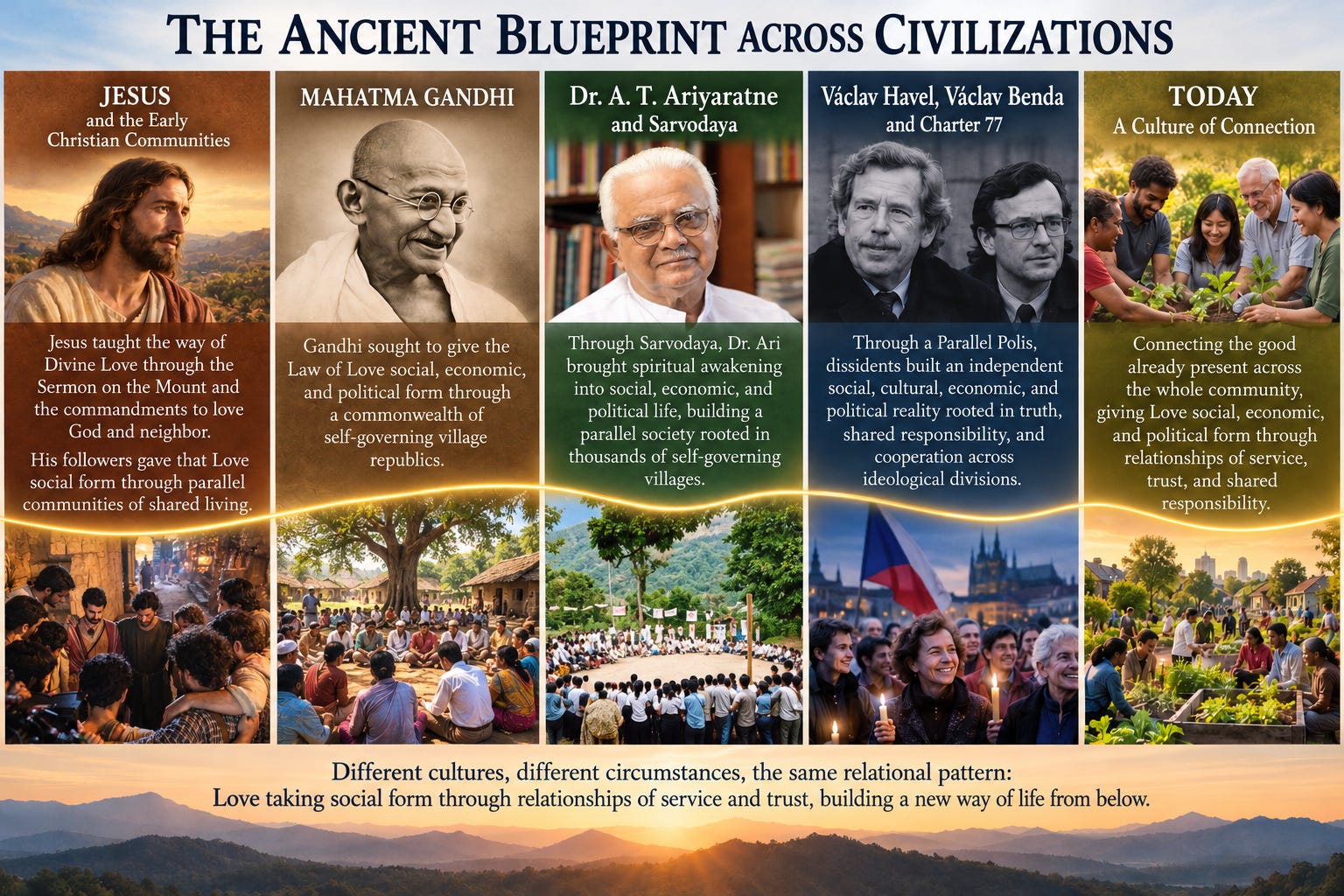
Their strength came from bringing different parts of society together through shared service and responsibility, without requiring everyone to embrace a single vision of the future.
Our circumstances today are different, but the deeper possibility of a Parallel Polis remains: people recovering the freedom and capacity to live, serve, cooperate, and assume responsibility for their common life. Building a parallel society does not mean separating from the rest of society. Independence from dominant systems and separation from our fellow citizens are not the same thing.
Connecting the Good: Giving Love Social Form
But building a whole-community Parallel Polis required something more than a different way of organizing society. It required something of me personally.
When I made a commitment to unite my whole community, I began to see how divided I still was inside. I had never even questioned my assumption that my worldview was right for everyone.
I had spent years defining myself by what I opposed: religion, business, the West, and people who didn’t share my worldview. I wanted to bring everyone together, yet I still saw many of them as the problem.
I share this because I see the same contradiction in movements today. We say we want to change society, yet we still approach people who don’t share our worldview as people who need to change.
The irony was that long before this work, I had experienced Love as the underlying structure of reality. My understanding of that Love began with Jesus, whose life and teachings revealed its Divine Source and showed me how to live it. I had felt myself held in that Love, connected with everyone else as part of one humanity, one family, even amid our real divisions. But knowing that and living it with people whose views I opposed were two different things.
I stopped asking others to join me and began showing up for them instead.
Rather than starting with a program, campaign, or worldview others had to embrace, I began with the community as it was, getting to know my neighbors and people involved in local businesses, faith communities, and organizations.
I listened, learned what mattered to them and what they were already contributing. We discovered that the twelve community needs created a shared context to uplift the whole community instead of only pursuing our separate issues. They were not twelve more issues around which to organize separate movements, but common ground for people who did not share the same worldview.
As people get to know and trust one another, they begin taking responsibility for more than their separate projects. Together, they build symbiotic networks that strengthen their local economy and food systems, care for neighbors, improve education and health, and protect their environment.
Over time, the relationships formed through this work grow into lasting organizations, institutions, and new ways of organizing community life. Together, they create a social architecture that reflects the underlying order of Love itself. The Love I had experienced inwardly was becoming a way of treating others, working together, and ultimately organizing the common life of our community.
From Local Communities to a Worldwide Commonwealth
I call the circles and networks that connect people across a community Symbiotic Circles and Symbiotic Networks. They begin with small circles of trust and service, then reach across organizations and sectors, connecting people who might otherwise remain separated.
Rather than gathering everyone into another movement organized around a shared worldview, they bring people and existing institutions together without taking control of their work. As these relationships deepen, people gain greater power to shape their community’s future. They develop new ways to meet shared needs, build their local economy, and make decisions together.
Connecting the good isn’t the ultimate goal. It is how people begin recovering their collective power to build a new social, economic, and civic reality together. Political power grows from these relationships, shared responsibility, and collective capacity. Love has political consequences without politics being where the process begins.
This is how a whole-community Parallel Polis emerges: not through one movement expanding until it replaces all others, but through the relationships and institutions people build together across the whole community.
Imagine thousands of communities around the world doing this, each building a shared future together while forming connections with other communities. Together, they create a worldwide commonwealth of communities.
From local communities to a worldwide commonwealth, this is what I mean by giving Love social form universally.
Love becomes the activating principle of a transformation unfolding simultaneously in communities around the world.
That Love shapes how people relate to one another, build institutions, and live together in community, giving rise to a global Culture of Connection.
We don’t have to wait. One person willing to reach across differences and recognize, serve, and connect the good already present throughout the community is enough to begin.
From Movement Organizing to Whole-Community Building
And that person doesn’t have to start from scratch. The foundations of this quiet revolution are already present in the extraordinary good that people and organizations are doing throughout the world.
Consider its scale. Globally, we have:
Approximately 10 million formal nonprofits and an estimated 50 million grassroots associations and community groups.
4.4 million Christian congregations worldwide, alongside religious communities of other faiths.
Approximately 10 million social enterprises addressing social and environmental needs.
Across Europe and the US, an estimated 700,000–850,000 Christian congregations and more than 700 million Christians among 1.1 billion people.
Approximately 2.1 billion people volunteering monthly, mostly outside formal organizations.
Hundreds of millions of micro, small, and medium-sized businesses supporting livelihoods and local economies.
More than one hundred million organizations, community groups, and businesses already involve billions of people. Through their everyday work and service, they are already laying the foundations for a whole-community revolution, whether or not they identify with a social-change movement.
Within this larger world are movements working to change different parts of society. These movement threads include:
Faith and spiritual communities
Charities and social-change efforts
Civic engagement and bridge-building movements
Regenerative culture and creation-care movements
Purpose-driven businesses
New Economy and commons movements
Localization and bioregional networks
Pro-democracy and civil-society movements
Arts and cultural communities
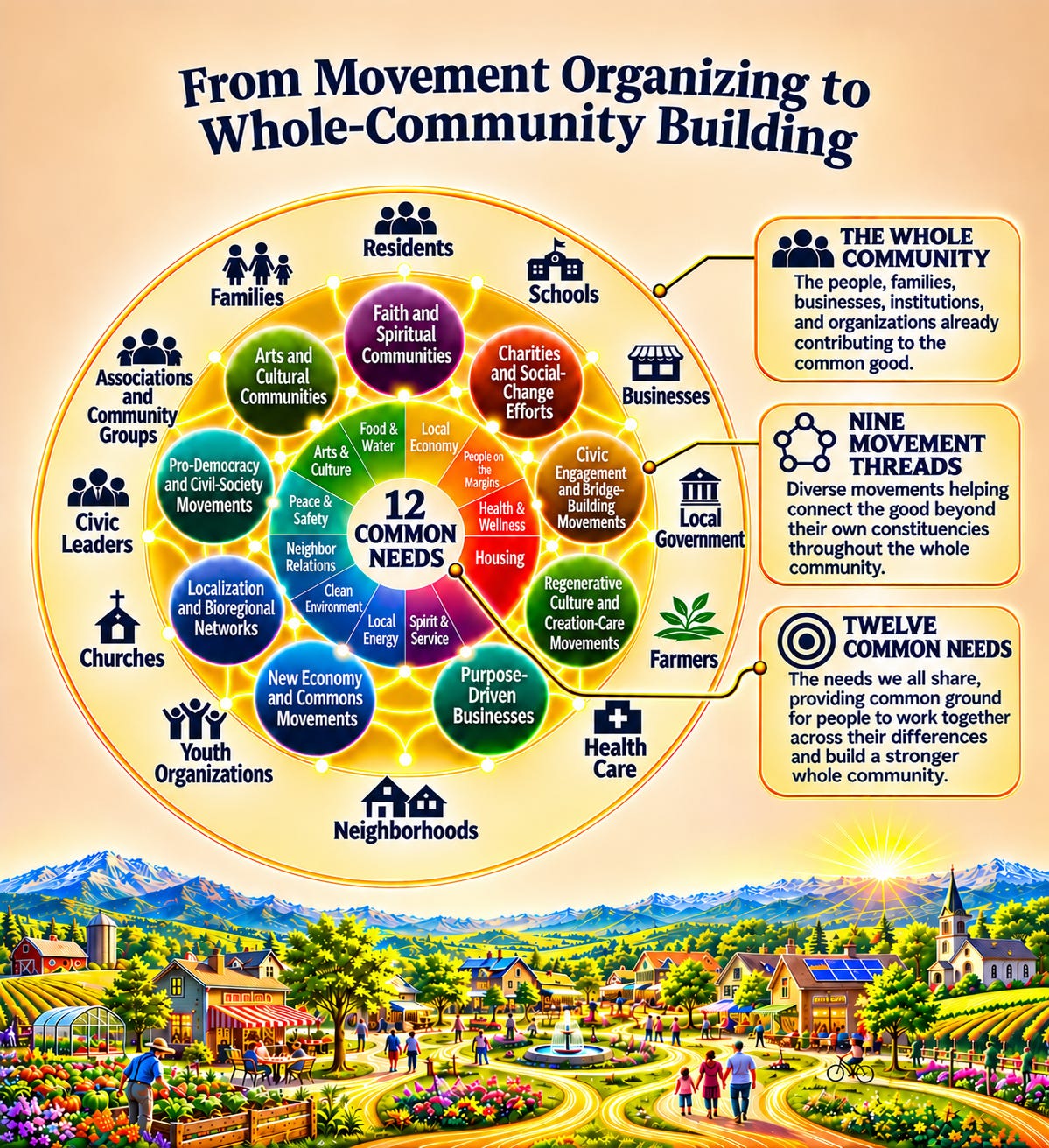
If the good is already present on an extraordinary scale, why does society remain so deeply fragmented? These movements are already doing extraordinary good, each contributing its own vision of a better society. But no movement can transform society on its own.
It’s the separation between movements, institutions, and worldviews that prevents their efforts from becoming the collective power of the whole community.
People don’t have to join a movement for social transformation. Their contributions are already part of the good transforming society. Whole-community building begins with these people, organizations, and institutions already present throughout society, not with expanding our separate movements.
Our task is to connect that good across the whole community and across communities worldwide, unleashing the greatest collective power for social transformation in history.
The Invisible Revolution: Connecting the Good That’s Already Among Us
Even efforts to unite diverse movements draw boundaries around who belongs, based on an unacknowledged shared worldview. In his 2007 book Blessed Unrest, Paul Hawken identified a vast global movement working for environmental sustainability, social justice, and indigenous rights. He then sought to connect these organizations through a platform called WiserEarth.
Yet this mainly progressive political vision still created a divide between those recognized as part of social transformation and those outside it. Movements like this don’t merely separate us from others. They shape our ability to recognize the good already present outside them.
Connecting movements around different causes is not the same as connecting the whole community across different worldviews. That is why overcoming the Culture of Separation requires us to expand beyond movement-centered organizing to whole-community building.
But who will take responsibility for connecting the people and organizations already doing good throughout our communities? Individual community members and people within existing organizations can become bridge-builders. They bring these groups together, help them build relationships, and connect their efforts with the wider community across differences in worldview.
I saw why this distinct role matters at the founding gathering of our Northern Nevada Local Food System Network. The executive director of the local food bank stood up before nearly a hundred community leaders. She told us she’d wanted to bring people together like this for ten years but had never found the time or capacity to make it happen. She was grateful and relieved that someone had finally taken on the work.
Many people are already busy serving their own organizations and communities. But others, including volunteers within those organizations, have the time and willingness to connect the good across the wider community. Organizations can help by inviting people in their networks to become bridge-builders. Getting started doesn’t require a budget, paid staff, another organization, or changes to existing organizational structures.
Whole-community building begins when people practice Symbiotic Kinship. They reach across their differences, build relationships, and connect the good already happening around them to meet their shared Common Needs.
This brings together people who might otherwise remain in separate worlds: the farmer, the restaurant owner, the pastor, the businessperson, the neighbor, and the community organizer.
They begin acting together where their lives already intersect. That is how relationships become the collective power of the people.
Turning Social Change Right Side Up
This brings us back to why I believe we’ve gotten social change backwards. We’ve been trying to transform society by expanding our separate movements, rather than strengthening the relationships among the people and organizations who already make up the whole community.
We’ve made agreement with our worldview a condition of belonging to our movements, overlooking the extraordinary good work already happening on the ground in every community.
The deeper transformation begins beneath our movements, in how we relate to one another throughout the community. By connecting the good across our differences, we recover the collective power to build a new social, economic, and civic reality together.
This is how the universal Ancient Blueprint takes shape in local communities, each in its own way. In one community, people begin by strengthening their local food system and economy. In another, they come together to improve neighborhoods, public safety, education, health, or care for vulnerable people. The people, histories, cultures, and needs of every community are different. No one needs to give this transformation a name, claim it as their own, or control the whole community in order to participate.
So who is connecting the good across the whole community? Who will take responsibility for building these bridges and bringing together people and organizations across their differences?
I’m sharing these reflections to challenge all of us working for a better world to rethink how we approach social change. Let’s start building whole communities together. In my new book, Recovering the Sacred Pattern of Common Life, I explore how we recover the relational fabric of culture and community, giving Love social form as we build a new social, economic, and civic reality from the ground up.
The book is available to read freely on Substack, with no subscription required. I welcome your thoughts on how we put whole-community building into practice and transform society together.
Bravo Richard. 👏👏👏
Je crois qu’on est de plus en plus nombreux, dans tous les pays du monde, à vouloir développer notre vie intérieure.
Il y a encore un énorme travail à faire pour créer des espaces, libres et sécurisés, réunissant à travers la planète les personnes en recherche d’intériorité.
can you share where you sourced your stats?
thanks for sharing your experience of what’s possible when we challenge the stories we hold as “a singular truth” instead of interpretation. i’d call this capability a cornerstone of our collective ability to transform our experience of life, and would love to hear how you’re continuing to cultivate this. TY.