

The other day, a LinkedIn conversation with Daniel Christian Wahl, one of the leading voices in the regenerative movement, became a turning point for me. I challenged a fundamental assumption: that building a regenerative society begins by bringing together people who share a regenerative vision.
I now realize just how counterintuitive that challenge sounds. While writing my book, Birthing the Symbiotic Age, I spoke with hundreds of leaders across many movements, each with their own vision of a better world. But when I proposed building bridges between movements and the wider community, none showed interest. Their focus remained on growing their own movements.
It took me years to understand why.
I was questioning something so deeply embedded in movement organizing that we rarely stop to examine it: the assumption that we transform society by building stronger movements.
Here is the paradox: leaders committed to transforming society are often deeply invested in the very organizing strategies they have spent years developing. Those strategies shape not only how they work, but how they imagine social transformation itself.
This organizing pattern extends far beyond regeneration. In this series, I will examine the organizing strategies of our social-change movements, beginning with regeneration and continuing with ecocivilization, Christian churches, Oneness and New Age movements, and civic engagement.
My purpose is to question these strategies, not to attack people, movements or their ideas. I draw on more than 40 years of grassroots community organizing, including what I have learned about what works and what doesn’t. It’s time to ask an uncomfortable question about the movements to which so many of us have devoted our lives:
Why, despite thousands of movements devoted to creating a better world, do we remain more fragmented and polarized than ever?
Expanding the Parts or Building the Whole?
In his article, Collaboration and Empathy as Evolutionary Success Stories, Daniel describes how life thrives by integrating diversity into interconnected wholes. His diagram contrasts a vicious circle driven by fear with a virtuous circle sustained by love.
What catches my attention is his distinction between the “maximization of parts” and the “optimization of the whole.”
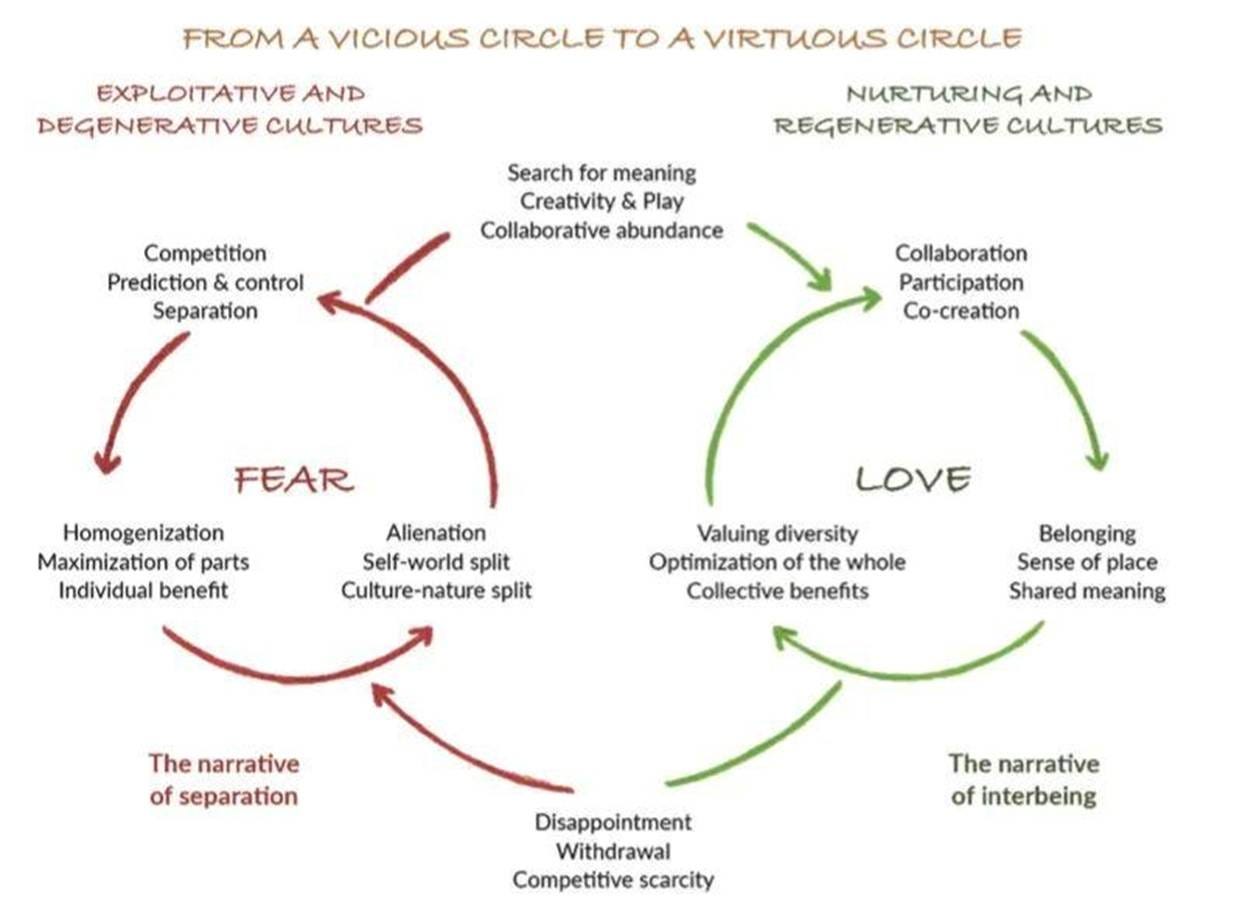
I believe this distinction points to a contradiction at the heart of how we organize social change. But are our movements putting Daniel’s principle into practice? Are we strengthening the whole, or are we strengthening our own part of it?
The regenerative movement celebrates diversity and seeks to overcome separation, yet even when it brings people together across differences, it organizes their collaboration around its own regenerative vision and agenda. It champions belonging yet implicitly makes agreement with a regenerative worldview a condition for feeling that one truly belongs. I call this agreement before belonging.
And here is the greatest irony: an ecosystem does not thrive by expanding one favored group of organisms, but through relationships among all its diverse parts—even those we consider undesirable.
So why do we seek to regenerate whole communities by expanding networks around a shared regenerative vision rather than connecting the people already there?
Daniel points to his work on Mallorca as an example of building relationships across differences. I don’t question the collaboration, trust or diversity he fosters. But whose vision shapes what the wider community is invited to build?
Mallorca: Building a Movement or Building a Whole Community?
Daniel helps bring together seven organizations working in organic agriculture, marine conservation, rural development, permaculture and ecological restoration through the Land & Sea Alliance of Mallorca. The Alliance describes itself as: “an alliance of organisations committed to the ecosocial regeneration of Mallorca.”
These organizations do valuable work. But notice what brings them together.
Despite their different activities, they unite around a shared vision of a regenerative community, economy and culture—an already-established agenda for transforming Mallorca.
Daniel also connects the Alliance with Commonland and the wider Iberian Network of Regenerative Territories, which describes its work: “We connect farmers, consumers and public actors who are already developing regenerative projects.”
Commonland describes its approach in similar terms:
“The 4 Returns Framework unites all landscape stakeholders around one shared goal: restoring their landscape while creating a sustainable income for local communities.”
The network becomes larger. It becomes more diverse. It operates across more sectors of society. But the organizing purpose remains regeneration.
Juan del Río describes how the Alliance builds trust, develops shared governance, raises funds and establishes priorities. In November 2026, he describes the end of “phase zero.” The Alliance now reaches out to people working in circular economies, social innovation and economic transformation. The goal is to develop a Regenerative Landscape Plan for Mallorca.
Daniel explains in a recent interview: “What we’re trying to do in Mallorca is move beyond those separate organizational stories towards a shared story of the place.”
This is a beautiful intention. Yet the regenerative organizations develop their shared vision, relationships, governance and priorities before reaching out to other parts of the community to advance that vision.
What is being built—a wider network organized around regeneration, or the whole community organized around its common life?
When Our Vision Divides Us
Here is something I have learned from experience. Even when we sincerely welcome everyone into our movements, the people who respond most readily to our invitation are those who identify with our language, values, worldviews, and vision of change.
In his earlier work, Juan organized talks and workshops on “post-capitalist socio-ecological alternatives, degrowth, alternative economics.” Daniel writes that “capitalism is broken and structurally degenerative.”
I agree with much of what Juan and Daniel are working toward: relocalizing economies, strengthening communities and transforming our relationship with nature and one another.
But imagine a small business owner who has spent thirty years building his business, employing local people and supporting his community. How does he feel when he hears the words post-capitalist and degrowth?
He cares deeply about protecting Mallorca’s environment, supporting local agriculture and strengthening the local economy. He also believes in private enterprise, free markets and economic growth.
Why begin with an economic worldview that separates him from people with whom he shares so many practical goals?
The Alliance itself advocates economic transformation. In an interview with the Mallorcan publication Fora Vila, its coordinator, Jordi Oliva, rejects perpetuating the existing economic model and calls for economic activity aligned with ecological restoration. The Alliance seeks to bring more businesses into an effort whose economic direction it has already established.
The Alliance does not require business owners to reject capitalism. But its vision of economic transformation precedes their involvement. The invitation might be open to everyone, but the invitation itself is not neutral.
I experienced this same tension at a New Economy conference in 2017. I was sitting in a room with about twenty wonderful people imagining different “New Economies.” They spoke of cooperatives, the commons, and other alternatives to the dominant economy. I shared much of what they hoped to create. Yet as I listened, I began to feel as though I were in the wrong room.
Finally, I raised my hand. “I’ve been listening to your vision of the future,” I said, “and I don’t feel welcome here. I own a private corporation, and I don’t feel like there’s a place for me in the future you’re describing.”
The same pattern extends beyond economics into spirituality. The regenerative movement often elevates Indigenous wisdom and Eastern spiritual traditions while portraying Western religious traditions, particularly Christianity, as contributing to humanity's separation from nature.
This creates an unconscious bias toward certain spiritual worldviews, even when people from other traditions share the movement's concern for the natural world and their communities. Once again, people are being separated by their beliefs rather than brought together through the good they share.
The problem is not whether exclusion is deliberate. It is the natural consequence of organizing around affinity. The separation begins before anyone even comes into the room.
And changing our language to attract more people into our movements does not address the underlying problem.
We need to change what we organize around in the first place.
A Regenerative or a Whole-Community Economy?
This issue extends well beyond Mallorca. Benjamin Life, another voice in the regenerative movement, writes in his Regenerative Accelerationist Manifesto: “A regenerative civilization is inherently post-capitalist.”
In an exchange with Benjamin on X, I questioned whether the language of post-capitalism separates us from traditional business owners who share many of our practical goals. His response was “Hard disagree.” He explained that “workers & conscious capitalists fit in this membrane.” But why begin with a membrane?
Why not begin with the businesses that already make up the local economy, recognizing the good they contribute to the community, regardless of their economic worldviews?
Benjamin proposes building worker cooperatives, community land trusts, local currencies and bioregional financing networks. He seeks to connect these institutions into a parallel economy that grows as the existing system breaks down.
I see great value in these economic alternatives. But where does this leave the hundreds of millions of traditional, privately owned businesses that already make up the economic life of our communities, worldwide?
Think about the family-owned restaurant, the local baker, the mechanic, the construction company and the conventional farmer. They meet our everyday needs, employ our neighbors and sustain relationships over generations. Many already do the very things the regenerative movement advocates: circulate wealth locally, create mutual benefit and contribute to community wellbeing.
A family-owned business with decades of reciprocal relationships in its community might contribute more to the health of that community than a newly established worker cooperative. What matters is not simply its ownership structure, but its relationships and contribution to the whole.
How do we build a whole community without building a whole-community economy?
Benjamin’s approach brings me back to Mallorca. His parallel economic alternatives and Daniel and Juan’s territorial alliance are different initiatives, but they share the same organizing pattern: begin with a regenerative vision, build a network around it, and invite other parts of society to participate. Even a broad regional regenerative network remains one part of the community.
How does that network regenerate Mallorca without connecting and invigorating the island’s whole economic life?
The alternative to an extractive economy is not simply a parallel regenerative economy. It is the regeneration of the whole community’s economy.
Why Stronger Movements Don’t Make a Stronger Community
Imagine a town where the regenerative movement grows while Christian churches expand their ministries, civic engagement organizations recruit participants, and other movements promote their visions of a better society. Each builds relationships, raises funds and attracts people.
In effect, our movements compete for market share—for people’s attention, time, participation, money and commitment. Each seeks to transform the same community by bringing people and institutions into its own network.
What happens if every movement succeeds? We end up with stronger movements, but not necessarily a stronger community.
We need a radically different strategy for social change. When I have shared my whole-community approach, many leaders have perceived it as another movement competing with their own. Yet I am not building another movement. I am saying that all of us need to build bridges between our movements and all the other parts of the community.
No movement operating in isolation from the rest of society will ever create a regenerative society.
Yet we continue to try to integrate the whole by expanding its separate parts. This is what I call the Culture of Separation. The regenerative movement’s vision of a healthy, interconnected society will never materialize through this organizing logic.
Northern Nevada: Where We Discovered the Ancient Blueprint
My understanding hasn’t just come from studying systems theory or reading books about regeneration, but from decades of grassroots community organizing and connecting with hundreds of movements.
In Northern Nevada, we did not begin with regenerative farmers and then reach outward to conventional farmers. We began with the local food system itself, connecting conventional and regenerative farmers, their organizations and other participants in the local food economy.
And here was the counterintuitive result: by focusing on the whole food community rather than expanding the regenerative movement, we helped the regenerative organizations grow.
They developed relationships throughout the wider food economy, while conventional farmers encountered new ideas and practices through people they came to know and trust. We did not need to persuade conventional farmers to become regenerative farmers before bringing them together.
One unexpected benefit was that the largest conventional producer in the area chose to go organic. The work of regeneration flourished through relationships that were not organized around regeneration.
This experience revealed something deeper: we were not inventing a new way of organizing. We were rediscovering an ancient pattern of common life grounded in love, reciprocity and mutual benefit across our differences.
I recognize this same pattern in the teachings of Jesus and the early Christian communities, Gandhi’s village-centered work, Sri Lanka’s Sarvodaya movement, the Parallel Polis by Charter 77 dissidents in communist Czechoslovakia, and Poland’s Solidarity movement.
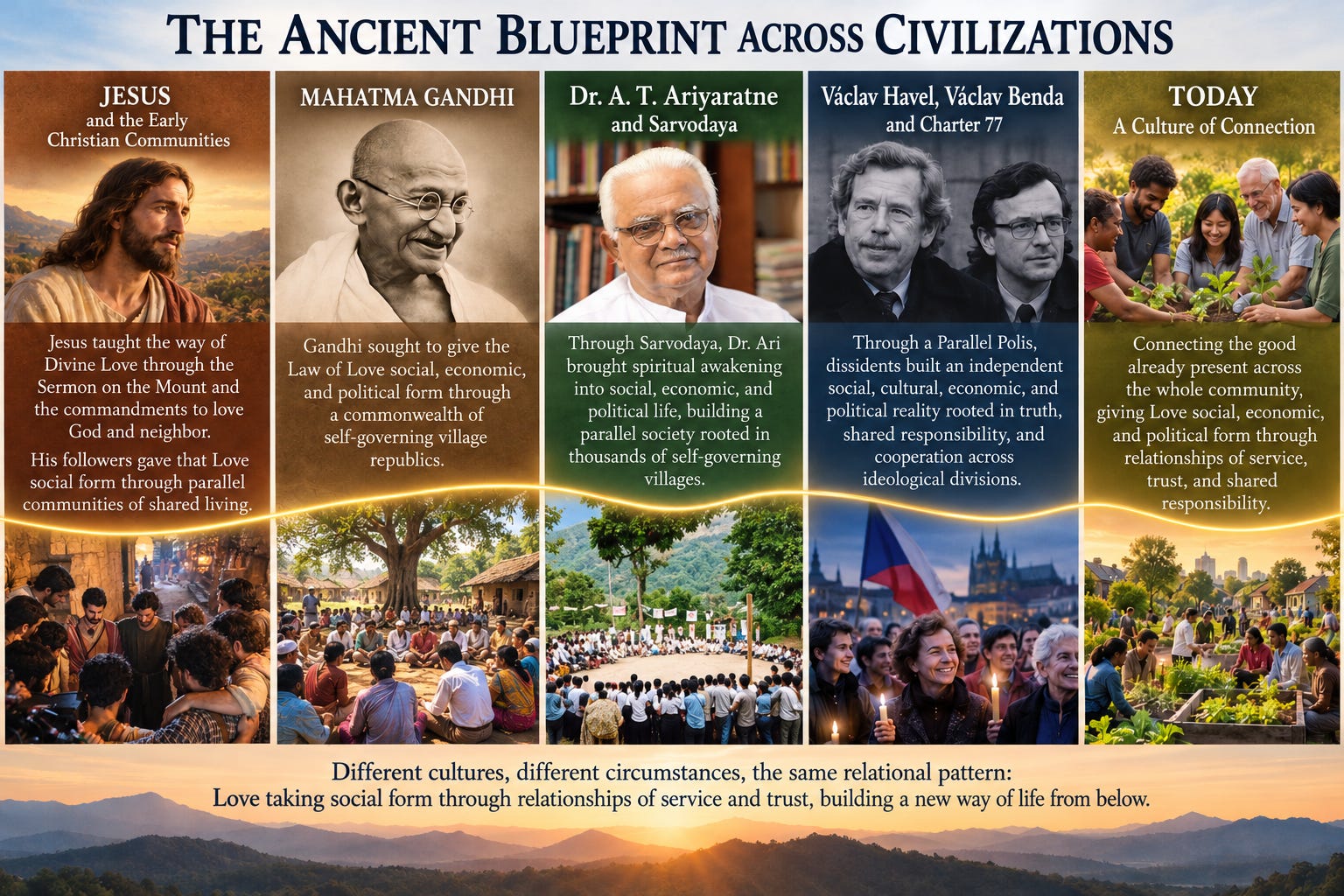
I call it the Ancient Blueprint.
Different times, cultures and circumstances, yet the same underlying principle: bringing people together through the good they share rather than the beliefs that separate them.
Building a Whole-Community Parallel Polis
I am not suggesting that our movements abandon their identities, beliefs or valuable work. I am saying that alongside traditional movement organizing, we develop a fundamentally different approach: whole-community building.
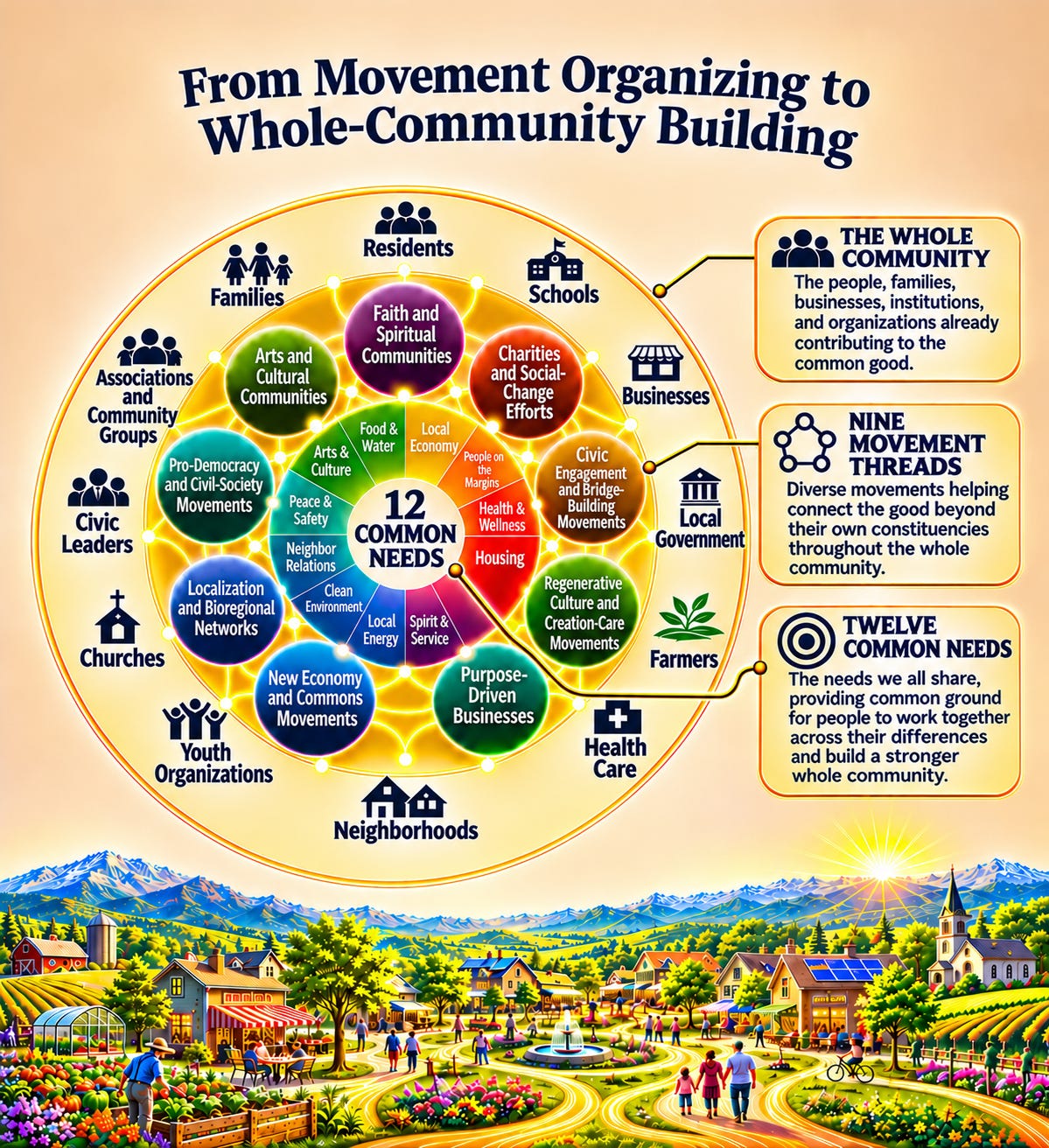
The local economy provides a powerful foundation for this work. We all participate in it. We all need food, housing, energy, healthcare and meaningful work. By meeting these needs together, we develop relationships of trust, reciprocity and mutual benefit across our differences.
This is the economic foundation of what I call a Whole-Community Parallel Polis.
Rather than build an alternative society around a particular movement or worldview, we begin with the people, businesses and institutions already in the community.
By connecting their strengths and resources, across worldviews, we build our collective capacity to meet our own needs, strengthen our local economy and increasingly govern our own common life.
New cooperatives, regenerative businesses, local currencies and community-owned institutions have an important place in this process. But so do traditional businesses, conventional farmers and the countless other people already serving the community. We connect the good they bring and strengthen their relationships through working together to meet shared needs.
What if the shared story of Mallorca emerges from the relationships between its farmers, businesses, families, churches, schools, civic organizations and environmental groups—not from the expansion of a vision developed by one part of that community?
And this brings me back to Daniel’s diagram.
The challenge is not simply to create virtuous circles. It is to transcend the boundaries between our circles so that the whole community becomes a virtuous circle.
That is the difference between building a regenerative movement within the community and building the whole community in a way that allows regeneration to emerge.
Our movements are already part of a larger community, not the other way around. The whole community is not the destination. It is where we begin.
For a deeper discussion of this different organizing strategy, see my earlier post, From Movement Organizing to Whole-Community Building, and the broader essay linked there.
This essay reminds me of the Basque region and specifically Mondragon corporation, where there is a cultural value of markets enabled by well-being. Thanks!