

Over the years of writing Birthing the Symbiotic Age, and through decades of working in real communities, I began noticing a pattern that now seems almost universal.
Every movement carries the belief that if enough people adopt its framework, worldview, religion, spirituality, politics, or way of organizing, society can be transformed.
I understand that impulse because I have felt it myself.
But after forty years of watching sincere movements and communities emerge, evolve, and sometimes dissolve, one insight kept returning:
No single movement, ideology, religion, framework, protocol, or network can regenerate society alone, because fragmentation itself is the deeper crisis.
The great challenge of our time is not merely that we lack solutions.
Across society, countless movements and communities are already responding to spiritual hunger, political polarization, ecological breakdown, economic inequality, and social isolation.
The deeper challenge is that these efforts often remain fragmented from one another.
Again and again, I watched sincere communities develop strong internal coherence, then slowly become siloed and self-contained. Whether churches or spiritual communities, civic initiatives, regenerative networks, or cultural movements, they often developed their own language, assumptions, and moral frameworks, often without building bridges beyond their own circles.
Here are just some of the movement threads already doing vital work:
• Churches and spiritual groups
• Charities and social change efforts
• Civic engagement and bridge builders
• Regenerative culture movements
• Faith-based creation care initiatives
• Purpose-driven small businesses
• New economy and commons movements
• Localization, bioregional, and cosmolocalization networks
• Pro-democracy and civil society movements
• Arts, culture, and creative community projects
• Local food sovereignty and permaculture movements
• Cooperative and mutual-aid initiatives
• Intentional communities and cohousing projects
• Open-source, decentralized, and digital commons communities
• Multi-faith and intercultural dialogue initiatives
Each of these movements carries real wisdom, cares deeply about humanity, and responds to real fractures in modern society. Yet even movements dedicated to healing fragmentation can unintentionally reproduce it in subtler ways.
The missing civic capacity is not coordination within groups, but the cultivation of trust and cooperation between them.
Healthy parallel communities (a parallel polis) and revitalized institutions may be essential for cultural renewal, but without meaningful bridges between them, fragmentation simply reappears in new forms.
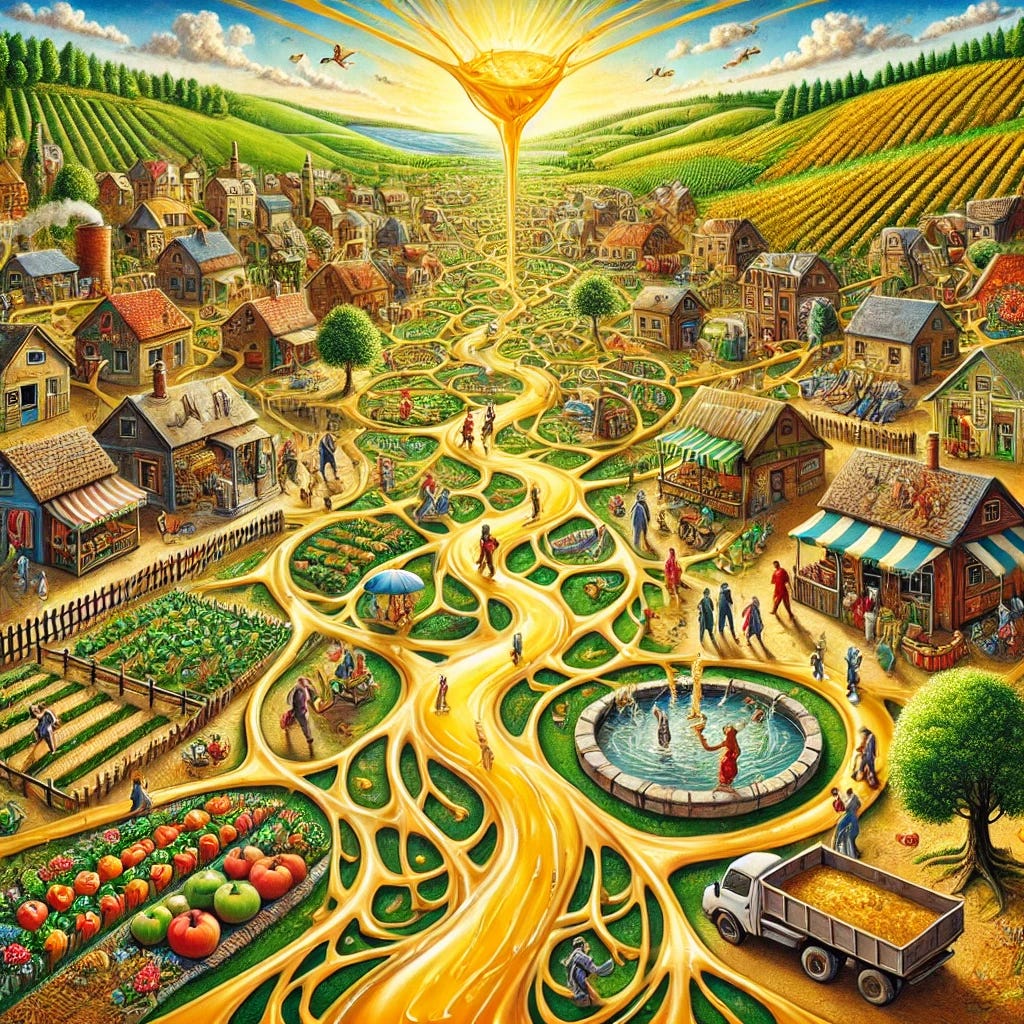
This does not mean giving up identity, convictions, or uniqueness. Families, faith communities, regenerative networks, intentional communities, local economies, and religious and spiritual traditions all matter deeply.
The invitation is not to dissolve difference, but to expand responsibility: to include bridge-building as an essential function of a healthy society.
What’s needed is not just new systems and structures, but a civic operating system grounded in Love: not as sentimentality, but as a practical organizing principle that enables mutual benefit, coherence, and right relationship at scale.
The question then becomes:
Can communities cultivate relationships beyond their own worldview?
Can they remain in meaningful connection with those who may never share their language, ideology, or metaphysics?
Can they become part of a larger living fabric rather than functioning primarily as parallel islands of coherence?
Increasingly, this feels like one of the central civilizational questions of our time.
The future may depend less on which movement ‘wins,’ and more on whether diverse communities can learn to become relational bridges within a shared culture of trust.
To learn more about the Book click HERE, or purchase below:

Richard, I love these observations; bridge-building would seem to be a core role at this time (and very appealling to the inveterate networkers among us!). I co-created a podcast called What Is Collective Healing? presented by the Pocket Project, a nonprofit dedicated to collective and inter-generational trauma healing, partly to build bridges between this field and other aligned organisations and networks. Would be curious to hear any more you want to write about how this bridge-building can be best pursued in practice. https://open.spotify.com/show/0g13FEQ7E8XsjPqh3t307f?si=58d9f7309ff8440e
This is so exciting for me. Recently you, or someone connected to you, sent us your book. Wow, my heart!! I'm still at the beginning because life is rather full atm, but it's like a beacon of light and wonder for me, sitting there waiting for me to pick it up at odd moments. What a joy! So rich!
I'm so excited to have met you!! Because, I've been feeling/dreaming about what you have been exploring for a very long time, it seems. And now I know I have someone with experience to lean into. What a relief!!
I'm sure there are others too. And, well, our foundations are so similar. Love!
Plus, we are now a bit of a silo of " Purpose-driven small businesses". Heart of Business, a 20 plus year business teaching that "every act of business can be an act of love".
Our main offering is a Learning Community where amazing people bringing such beautiful gifts to the world gather. We teach both effective heart centered marketing and give witness and care for the healing journey being able to live in and market from your heart can be.
But back to the silo idea. I've been longing for a way to find a bridge between what we do and all the many beautiful folks around us and all over who are pretty different than us.
We live in Trump country. Very Christian. Farms and churches. Many lovely people, but they would not feel at home in our biz community. We are Jewish Sufi's for one, and strong on social justice in a way that might rattle many of our neighbors as well.
Yet I feel deep in my bones how much we all need each other. Now more than ever too!
And now I have you! Your book. Your Substack. I am bowing with deep gratitude and sitting gratefully at your feet as a student too. Thank you!