

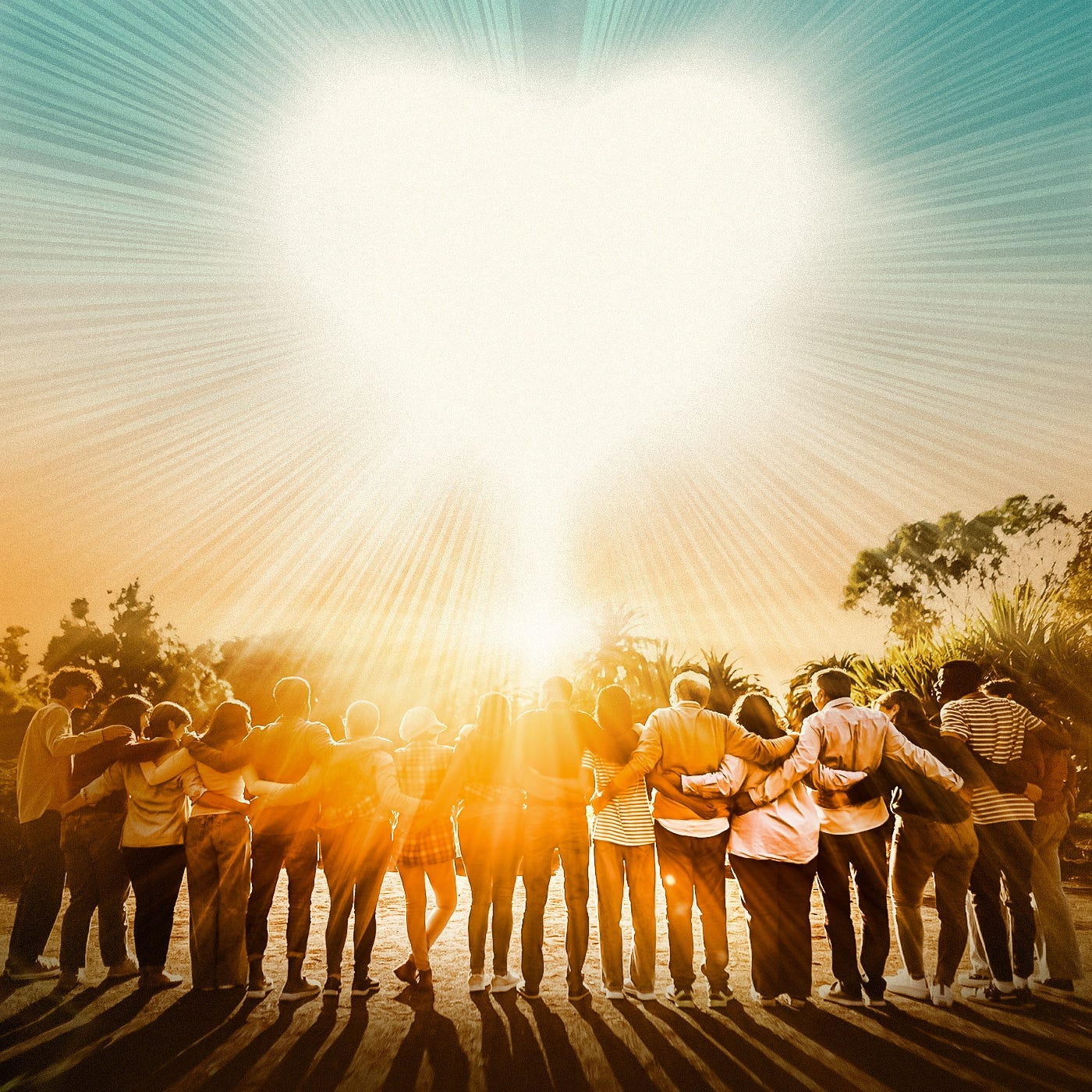
The Parallel Polis: Building Another Social Reality
When we live in alignment with the Ancient Blueprint, something remarkable can happen.
The pattern I had already begun to recognize was now clear: Divine Love becomes embodied through Virtue. Virtue shapes how we relate to one another. Relationship finds expression in service. Service strengthens community. And communities begin building the relational, economic, and civic structures through which another way of life can take form.
I had already seen the beginnings of this social reality. The good is already here. The islands of coherence are already in place.
The question now is how the Love already alive within these organizations, communities, and movements can flow between them and find expression in their relationships, creating greater coherence across the whole community.
I had encountered the Parallel Polis as one way this other social reality can take shape within and alongside the existing one.
This offered a third pathway for social change, radically distinct from the two familiar approaches I had encountered in my own life and work: The system is broken, so reform it. Or the system is broken, so leave it and build an alternative.
I came to see that, within a Culture of Separation, both pathways reproduce the very
separation they are trying to overcome: one by struggling to gain power over the existing system, the other by building an alternative apart from those who do not share its vision.
That recognition has changed how I understand the first path. I no longer believe electoral politics can bring about the change our society needs. Political victories may change laws and institutions but cannot change the relationships, values, and culture beneath them. In the realm of political parties, the struggle becomes a contest for the power to impose one group’s vision of change on everyone else. But lasting change must begin in the relationships, values, and culture of the people themselves.
But turning away from electoral politics did not make the second pathway any more viable. Building alternatives in isolation from one another is not the answer either. While writing my book, Birthing the Symbiotic Age, I encountered hundreds of movements, organizations, and leaders working to change the world for the better. Most begin with a shared vision of the change they want to bring about and naturally attract people who already agree with that vision.
Regenerative movements gather people committed to regeneration. Civic engagement efforts bring people together passionate around civic engagement. New-economy initiatives bring together people who share a particular economic vision. Christian and spiritual communities gather around their own beliefs and practices.
The boundaries of the shared vision come to define who is inside and who is outside the movement. Once again, agreement came before belonging.
Movements reinforce those boundaries when they define themselves as much by what they oppose as by what they hope to create. I encountered this directly in responses to my own work. One of my Substack readers wrote to me, “Richard, I love your vision, but the West and capitalism are evil, and we need to move beyond them, not cooperate with them.”
I understood the impulse because I had once approached social change in much the same way. In the 1980s, I participated in civil disobedience in San Diego against first-strike nuclear weapons, working alongside progressive and even communist organizations while seeking to build alternatives. I’m ashamed to say that I sometimes referred dismissively to people outside our activist circles as “normies”: ordinary families raising children, going to work, attending the PTA at their neighborhood school, people who, in my eyes, simply didn’t get it.
I wanted to transform society, yet my moral self-righteousness disconnected me from the very people whose lives I claimed to care about.
Entering the Life of the Community
Eventually, I had to confront a question I could no longer avoid:
How could we hope to transform a community while remaining apart from the everyday lives of the people who made up that community?
Gandhi had already shown another way: rather than simply replacing those in power or retreating into an alternative society, he sought to rebuild India from within the life of its villages. Speaking before India’s political and intellectual elite in 1916, he challenged the notion that they could bring freedom to India while remaining disconnected from its ordinary people.
He insisted that India’s salvation would come through its farmers, not its lawyers, doctors, or wealthy landlords. For Gandhi, that meant standing alongside the millions working in India’s fields, entering into the realities of their everyday lives.
Gandhi was also part of the spiritual lineage I had been tracing, one that reached back to Jesus and the deeper reality of Divine Love. His vision of social transformation had been profoundly shaped by Jesus’ teachings in the Sermon on the Mount, which he understood as expressing what he called the law of love.
He did not speak of that Love merely as a moral ideal, but as something woven into the underlying order of reality itself. As he put it, “Whether humanity will consciously follow the Law of Love, I do not know… The law will work just as the law of gravitation works…”
Nor did he leave that principle at the level of belief. It has to be lived. As he put it elsewhere, “And if that is the law of life, we have to work it out in daily life.”
Over time, I came to understand what that meant for my own work in communities.
We cannot transform a community from within our own political or ideological world. We have to enter into the everyday life of the community itself.
I would later recognize this as the beginning of a Parallel Polis: building another way of life among the people and institutions already making up the community, alongside the existing social order.
Decades of community work had taught me what that could look like. I ran nonprofits and businesses and worked with government agencies, churches, activists, business owners, neighborhood leaders, and ordinary people. The “system” was not something abstract outside the community. It was woven into the community itself.
That raised a practical question: how could we possibly build another culture and economy without building relationships across the wider community? After all, we would still live alongside businesses, workers, nonprofits, governments, churches, and institutions that did not share our vision.
The same problem exists among movements themselves. Thousands of movements work in parallel, each building its own piece of a better world and attracting people who share its vision. But what connects them? Is their theory of change simply to keep growing until enough people join? And what about everyone else?
Here’s the irony: we can create something beautiful among people who share our vision while remaining disconnected from the larger community we hope to transform, making that vision virtually impossible to achieve.
It was the islands-of-coherence pattern again. Without connections across movements and to the wider community, even the most promising efforts to build another social reality will remain isolated islands.
I recognized how easily I had fallen into that same trap, but I had also discovered another way.
The Third Way: Beginning Where You Are
Looking back at my community work, I recognized that I had been practicing another way for decades, calling it different things along the way: Conscious Community, re-villaging, and the Community Ark. I had been helping another social reality take root within the community.
I was building relationships across the differences that had divided us, among businesses, nonprofits, faith communities, civic institutions, movements, and ordinary people.
The whole community itself is the container.
People do not have to share the same worldview. They already share something more fundamental: they live in the same community, sharing its everyday life, challenges, and opportunities. They begin building a different way of living together right where they are, while remaining different from one another.
Relationship first, not agreement.
I had been practicing this approach long before I discovered that others had already described it. The Parallel Polis strategy gave me a name for what I had been building. But the underlying pattern was not new. It had taken different forms throughout history.
But I came to understand that “Parallel” did not mean separate.
We begin building this Culture of Connection within our existing communities, without following either of the two paths I had already rejected: fighting for political power or withdrawing into a separate world of people who already agreed.
This was not an entirely new approach. I had already recognized the same Ancient Blueprint that underlies this Third Way in the life of Jesus and the early Christian communities. Jesus did not organize his followers to capture Caesar and use political power to create a more moral society. Nor did he appeal to Caesar to reform the system. He began somewhere deeper.
He proclaimed the Kingdom of God, a way of living aligned with a Transcendent authority rather than the authority of any political or social system.
That deeper frame transformed the lives of his followers. They began living, loving, serving, sharing, and caring for one another in a different way. Within the dominant culture of empire, they were building another way of life. And the Love they practiced did not stop at the boundaries of their own community. Centuries later, even the pagan emperor Julian would lament that Christians cared not only for their own poor but for Rome’s as well.
That example brought me back to what I had learned through my own community work: the answer was not to create another movement. Through this Third Way, we build a whole-community Parallel Polis by cultivating relationships across the movements, organizations, institutions, and people already rooted in a community. Over time, those connections could form a “whole cloth” community network.
A whole-community Parallel Polis cannot simply be legislated into existence. We must practice it into being.
And much of what we need to begin is already here. Billions of people around the world participate in movements, faith communities, nonprofits, businesses, regenerative projects, and civic initiatives doing extraordinary work. The good already exists on an enormous scale.
But the main challenge of the age remained: the good is not absent. It is fragmented.
Simply doing more good within that same Culture of Separation will not overcome this fragmentation. We have been doing that for millennia, expecting more good works to bring about the changes we hope to see in society. But repeating the same approach is a dead end. We cannot transform the very systems that perpetuate separation by continuing to operate separately and expecting a different result.
This is why the Third Way requires us to connect and multiply the good already present throughout our communities in a new cultural context: a Culture of Connection. Rather than waiting for the culture to change, we begin living it through our relationships, transforming the larger culture from within.
The means and the end must be the same.
From Whole Community to Commonwealth
As this Culture of Connection takes root, the Third Way begins to reveal its larger political implications. As relationships grow, people gain the capacity to make decisions, meet shared needs, and govern more of their common life together.
As this whole-community Parallel Polis develops, another possibility emerges: a decentralized commonwealth growing from the life of communities themselves.
I was especially excited to discover that this possibility closely resembled a vision from my own American political tradition.
Thomas Jefferson envisioned what he called a “Commonwealth of Ward Republics,” a form of bottom-up federalism that would shift political power away from centralized government and back into the hands of people in their own villages, towns, and communities. What struck me was how closely Jefferson’s vision resembled Gandhi’s later vision of a Commonwealth of Village Republics, which Dr. Ari helped bring into practice through Sri Lanka’s Sarvodaya movement.
The resemblance was even more remarkable because these visions emerged in very different societies shaped by empire and its aftermath. Yet each pointed, in its own way, toward people reclaiming their capacity to govern their own communities rather than depending primarily on centralized institutions.
I recognized a similar principle in Catholic Social Teaching: subsidiarity. It holds that decisions and responsibilities should remain with people and their local communities wherever possible, with higher levels of authority supporting rather than replacing them. Here was another expression of this vision, rooted in a different spiritual and historical tradition.
These historical parallels reinforced what I had been discovering through my own community work: the foundations of a commonwealth could grow from the relationships people build within their existing communities.
Just as the Charter 77 movement in Czechoslovakia had helped build a Parallel Polis within and alongside the Soviet-dominated Communist system, we begin building a whole-community Parallel Polis by connecting people, businesses, faith communities, civic organizations, and local institutions across our own communities.
That whole-community approach is essential because no single movement can regenerate society in isolation. Each contributes something valuable, but none can accomplish that transformation alone.
But coming together does not mean becoming the same. A neighborhood can remain a neighborhood. A church can remain a church. A secular organization does not have to adopt my Christian language. A food network can remain a food network. Each can retain its own identity while building relationships with the others.
And that is where the Third Way begins. Each organization and community can build relationships with others around it, right where they are.
Fractal Community Empowerment
The possibility of transformation beginning within communities everywhere matters more now than ever. The empires confronted by Jesus, Gandhi, Ari, Havel, and Benda were immense, but today the political, economic, financial, and technological systems shaping our lives extend across the entire planet.
Yet this raised a question that had followed me through decades of community building: if transformation had to take root in the actual life of communities, how could the relationships we build and the changes we make locally transform society on a global scale?
I heard one answer from movements working for systemic change: our problems are global, so we need global movements powerful enough to change the political, economic, and social systems behind those problems. From another direction came the opposite answer: change yourself, serve the people around you, and somehow those personal and local efforts will transform global systems and structures.
These approaches no longer satisfied me because something essential was missing from both. Neither adequately explained how transformation in individuals, families, and relationships could grow throughout local communities.
More importantly, how could these local transformations give rise to new social, economic, and political structures at regional, national, and global scales?
The conventional answer to the question of how change reaches larger scales has been to build movements capable of influencing society. Most movements grow by attracting more people to their cause, network, or worldview. I had long accepted this approach, assuming that extending their reach required building larger organizations, raising more money, hiring more staff, and coordinating increasingly complex efforts.
In Reno, Nevada, however, our community-building work took a radically different approach.
Rather than bringing people into one expanding organization, we helped local food, local economy, and neighborhood networks take shape alongside one another, connecting leaders, businesses, nonprofits, and institutions already doing the work. These symbiotic “mediating” networks supported participants in building relationships, cooperating, and strengthening their collective capacity.
As those relationships multiplied, these informal, hub-centered networks grew without requiring any formal organizational structures, funding, or paid staff.
I began to see that the conventional approach to systemic change had the architecture backward. Instead of making organizational growth the vehicle for change, we were using these networks to connect and strengthen people and organizations already doing the work.
My training as a biologist helped me recognize a deeper pattern behind what I was seeing in Reno. Nature is filled with patterns nested within larger patterns, each part belonging to a larger whole. And as my relationship with God deepened, I came to recognize in creation something deeper: an underlying relational order rooted in Divine Love.
In Jesus’s simple teaching to Love God and Love Others, I recognized that same relational order: relationship to the Divine flowing into relationship with one another. But if human beings are part of creation too, how could that same deeper relational order really disappear from human society, or from within each of us? Or has the Culture of Separation simply made it harder for us to see? Nature offered another clue.
Think of a head of Romanesco broccoli. Break off a smaller branch and you see the same basic pattern. Zoom in or zoom out, and the pattern repeats. That’s a fractal.
I recognized something similar in our local food system network. It had begun one-to-one, with trust between people. Trusted relationships formed small circles, and circles connected into networks. As the network grew, these relationships began to form an increasingly interconnected structure.
I saw it happening among restaurant owners who had once viewed one another primarily as competitors. They began cooperating, sharing knowledge and resources. As farm-to-table efforts expanded, restaurants, farmers, and other businesses built a larger local marketplace where they could thrive together.
As I watched these relationships grow, I began to see how Divine Love could take social and economic form through the relationships we were building.
Two dimensions of fractal community network formation were becoming clear: the structure through which relationships could multiply and the shared virtues that could take root and spread throughout that structure.
Structurally, we began by connecting leaders of existing food-system clusters, including farming hubs, farmers’ markets, restaurants, food banks, institutions, and food cooperatives. What began as a hub-and-spoke network evolved into a multi-hub network as leaders brought their own relationships and connections into the process. As those connections multiplied, the network became increasingly self-organizing, with relationships and cooperation extending beyond the original hub.
At the same time, we were cultivating Symbiotic Culture DNA among participating leaders through shared Virtues, principles, and needs. As new leaders joined and developed relationships, trust, respect, service, and cooperation continued to shape how people worked together, even among those who had never met. As the network expanded, the same relational pattern was taking shape within individual relationships, among hubs, and across the wider network.
At first, I understood this primarily as a different way for change to spread. I was accustomed to linear growth: one became two, two became three, three became four. Exponential growth is much faster: one becomes two, two becomes four, four becomes eight. But both models still assumed that change spread outward from a single starting point. Even as I recognized the same relational pattern appearing at different scales, I was still thinking within that framework.
Neither model adequately explained the full potential of the fractal pattern I was discovering.
What if this relational pattern of change did not have to spread outward from a single center? What if it could take root in communities everywhere at the same time, as people connected the good already present among them?
From Attraction to Activation
That possibility required me to rethink what was the center of change. The network itself is not the source of the Love, trust, and goodwill flowing through it.
The Ancient Blueprint is a sacred relational pattern woven into creation and rooted in Divine Love, and that same pattern is already present throughout human society. The good is already here. But the Culture of Separation has fragmented its social expression, leaving that goodness scattered into islands.
What is missing, then, is not simply doing more of the good we are already doing. We need to build relationships between these islands of coherence, connecting existing networks across the whole community. Ultimately, we need to connect communities with one another.
Through symbiotic mediating networks, we began to connect people and organizations that had previously worked separately. We were creating a relational container that allowed the Love already alive within people, groups, and organizations to flow between them, bringing them together as a larger, interconnected community.
Seeing how these connections could bring a whole community together changed how I understood the possibility of transformation reaching across the world. If the same good is already present throughout human society, then transformation does not have to depend on one movement expanding into each new community.
Like mycelium extending through a forest, this relational pattern can grow in each community through connection: people forming circles, circles connecting with other circles, each becoming part of something larger. Instead of asking people to join one movement or adopt one vision, we invite them to connect the good already present where they live. And this requires a different approach to community empowerment.
Fractal community empowerment turns the conventional logic of attraction upside down. Rather than recruiting people to join our thing, we activate the goodness and capacities already present in our communities. We show up for people, helping them connect and succeed together without joining another organization or adopting someone else’s agenda.
But this shift from attraction to activation requires more than a different organizing strategy.
It requires understanding where true power comes from: Divine Love, expressed through holding space. Love gives us the spiritual fluency to move beyond our own agendas, identities, and judgments, making room for people with different perspectives to cooperate.
Rather than persuading or controlling others, we trust the Love already alive within them. The approach is simple, but not easy. It requires humility and the inner virtues to serve without controlling the outcome. Not everyone needs to do this work.
It only takes one person to begin. One person holding space in Divine Love can connect the capacities of many people and organizations, allowing them to become mutually reinforcing. In Reno, I helped foster networks around four of the twelve Common Needs, involving almost a thousand organizations, businesses, and local governments.
Imagine twelve people each fostering a network around one of those needs. No one person needs to organize or control the whole. The person holding space is simply a vehicle for Divine Love, whose power becomes active through the relationships and cooperation that emerge.
What If Change Begins Everywhere at Once?
If one person can help initiate this transformation in one community, why can’t others do the same in communities everywhere?
My experience with Sarvodaya answered that question. I had first encountered Sarvodaya in 1991, and in my visit to Sarvodaya villages in 2022, I began to understand more deeply how far this pattern could extend. I stood alongside people whose lives were rooted in immediate concerns: family, livelihood, food, health, and the needs of their community.
Yet they understood these ordinary acts of community life as part of something much larger: the awakening of their village, their nation, and ultimately the world.
There, I recognized something I had not fully understood before. Like many Westerners, I had tended to think of personal and systemic transformation as two different kinds of change. Dr. Ari did not separate them in that way. He understood whole-community transformation as bringing all the dimensions of community life into harmony.
The person does not have to become an insignificant cog in the wheel for transformation to reach a global scale. Nor does the community have to become a chapter of some standardized organization.
Instead, Sarvodaya showed me how communities could remain rooted in their own lives while becoming part of something larger. It revealed another dimension of fractal growth: the development of networks across multiple scales. Within each community, people develop psychological, physical, social, economic, and political infrastructure, grounding each in the same relational pattern.
As communities connect with one another, they also develop wider networks of cooperation, economic support, and civic participation beyond any one community. Today, Sarvodaya is a network of 5,500 active community societies across Sri Lanka.
Seeing this national community network take shape turned my understanding of systemic transformation right side up.
Rather than building change from the top down, communities can develop from within, connect horizontally across community life, and form regional and national networks from the bottom up.
Communities can begin where they are, tend their own roots, and become part of something larger without surrendering their local character.
If Sarvodaya could connect more than 5,000 communities across Sri Lanka, what is stopping tens of thousands of communities around the world from doing the same, each connecting the good already present within it? They do not have to become chapters of one organization, followers of one leader, adherents of one theology, or participants in a centrally controlled global movement.
Here was something fundamentally different from the linear or exponential growth I had once imagined. The same relational pattern does not have to spread outward from one center. It can take root independently in many communities at once, each expressing the same underlying pattern in its own way.
And this changed what starting locally meant. It did not mean changing the world slowly.
The same sacred Pattern could take root in communities everywhere, transforming relationships, institutions, and ultimately the structures of society itself.
Go to Discovery 6: How Love Orders Our Relations
New Book: Recovering the Sacred Pattern of Common Life
Check our all the Discoveries:
Discovery 1: The Good Is Already Here
Discovery 2: The Coherence Is Already Here
Discovery 3: The Blueprint Is Already Here
Discovery 4: How Love Bridges Worldviews
Discovery 5: How Divine Love Takes Social Form
Discovery 6: How Love Orders Our Relations
Discovery 7: How Love Becomes Social Architecture
Discovery 8: How Love Enters Economic Life
Discovery 9: How Love Becomes People Power
Discovery 10: The Whole Community Is Already Here
To learn more about my first book, Birthing the Symbiotic Age: An Ancient Blueprint to Unite Humanity click HERE, or purchase below: