

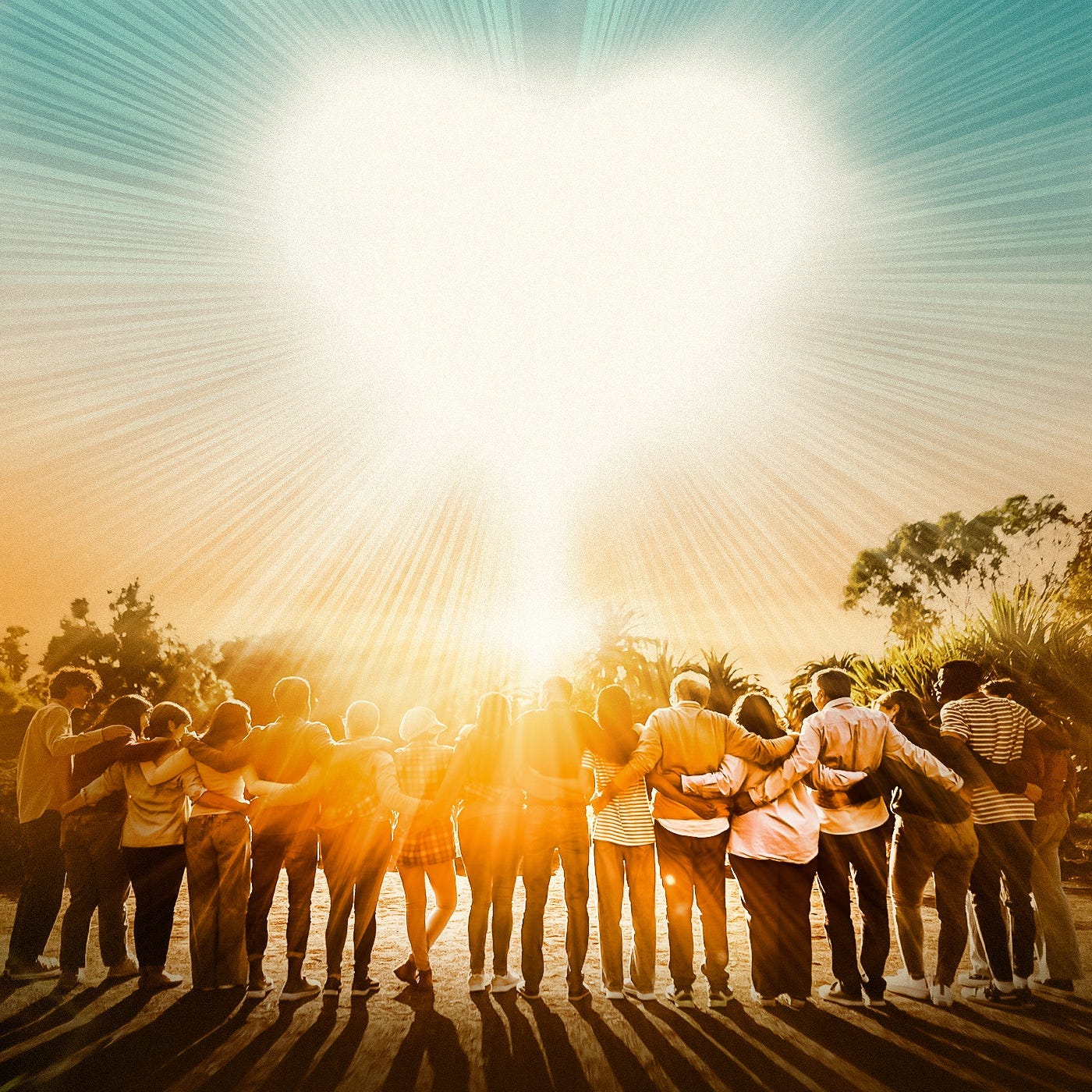
How Our Worldviews Become a Boundary
The Ancient Blueprint is not mine.
No movement, organization, religion, political philosophy, or historical period can claim ownership of the relational order I am describing. None of us invented it. We do, however, understand and interpret that deeper order through very different worldviews. And I began to see that those worldviews also created boundaries between us.
We don’t simply disagree about politics, economics, or culture. Beneath many of those disagreements are different understandings of reality itself: God, humanity, nature, consciousness, and what ultimately gives life meaning.
I encountered this in unexpected ways.
While writing my previous book, people encouraged me to use the word Oneness. It sounded wonderfully inclusive to me. I even remember a woman asking how she could bring more people into a movement built around Oneness.
I had assumed Oneness was about as inclusive a word as I could use. Then a conversation with a group of Eastern Orthodox Christian men challenged that assumption. For some, Oneness suggested an undefined underlying unity of consciousness, humanity, nature, or Earth. But for people who believed in a Creator distinct from creation, that understanding conflicted with their fundamental understanding of reality.
Moving among very different spiritual and cultural communities had given me the opportunity to notice distinctions I had not recognized while remaining within my own. I was learning to move among these different worlds while remaining rooted in my own faith, listening, learning, and understanding without needing to make their worldview my own.
If the language of our own communities becomes a boundary others cannot cross, how can we ever build a larger sense of belonging between them?
I encountered that boundary even more directly. I met with a woman deeply interested in building new forms of community. When I told her I was a Christian, she told me that Christianity and other traditional religions could not be part of what was emerging. In her understanding, nonduality represented the pinnacle of spiritual development, while traditional religion belonged to the past.
The irony stayed with me. A worldview centered on overcoming duality had itself created a division between those who shared that understanding and those who did not.
I could understand some of that wariness toward Christianity because I had once carried it myself. As a progressive organizer, I had come to associate traditional Western religion, especially Christianity, with hierarchy, judgment, political power, and histories of domination. Yet in many of the progressive, regenerative, and alternative-community circles I moved in, Buddhism, Indigenous spirituality, and other non-Western traditions were welcomed much more easily.
I began to recognize the bias in that distinction. Even communities seeking to transcend exclusion reproduced it by treating some spiritual traditions as sources of wisdom and others primarily as problems to overcome.
I encountered the same pattern in another conversation. Someone interested in my work told me that because I spoke openly about Jesus and identified as a Christian, our worldviews were too different for him to share my book with his community.
I didn’t object to our differences. They were real. What struck me was the assumption beneath the response: that different understandings of ultimate reality kept us from participating in the same work.
What sounded universally inclusive to me wasn’t universal after all. It actually excluded. I had already discovered how Christianity could become a boundary.
Now I was discovering that even Oneness could become one too. The deeper problem wasn’t simply which worldview was right. We were forming communities around shared worldviews, and those boundaries were keeping us apart.
I began to see that the “religious” impulse is more primal than organized religion itself. We can leave churches and creeds behind and still form tribes around politics, spirituality, or visions of a new society, complete with our own orthodoxies, heresies, insiders, and outsiders.
What Comes Before Agreement?
That realization took me back to something I had learned through experience in Northern Nevada. I had begun by organizing largely among people who agreed with me, sharing many of my politics, assumptions, and ideas about social change.
I had a worldview before I knew I had one, and it was already shaping the boundaries of the community.
I was building. Christian churches, for example, were largely outside the networks I was forming. I thought I was simply gathering people around a shared vision. Without realizing it, I was deciding who was in and who was out. Only later did I begin to see what that meant: the people who belonged most easily were the people who already saw the world much as I did.
Groups organized around shared beliefs and commitments could be wonderfully coherent. But over time, I began to recognize the same pattern in very different places. The beliefs and worldviews differed, but the organizing logic was remarkably similar: agreement came first, and community formed around it.
I was beginning to see that the problem was not simply which worldview we held, but what happened when we made our worldview the doorway through which others had to pass before they could belong.
Meanwhile, one of the efforts we were building in Northern Nevada was a region-wide network of more than sixty-five street-level neighborhood networks called Get to Know Your Neighbor. The idea was remarkably simple: help people living near one another get to know each other as neighbors. Many of those relationships grew into ongoing ways neighbors could care for, help, and support one another in everyday life.
We weren’t beginning with an issue or cause. We were beginning with relationship.
Only later did I understand the significance of that distinction. After recognizing how often I had done the opposite in my own organizing, I began seeing the pattern everywhere. I heard about two neighborhood efforts in the UK that initially sounded similar to Get to Know Your Neighbor. But one brought neighbors together around climate change and the other around conflicts with landlords.
Locally, in Reno, Nevada, a youth pastor friend told me his church would not participate unless they could use the neighborhood effort to preach the Gospel.
I began seeing the same pattern in regenerative and New Economy movements, nonreligious spiritual communities speaking of Oneness, Gaia consciousness, spiritual awakening, or higher consciousness, and political communities organized around their own visions of justice, freedom, or social change.
Different language, different visions. Yet the same pattern of agreement before belonging kept reappearing.
Here is the paradox: If we only build relationships with people who already agree with us, we can never become a whole community.
Belonging Before Agreement
Affinity can never be enough.
A whole community is one capable of holding people who disagree profoundly in politics, culture, religion, and philosophy without requiring them to become the same.
That’s when I realized that the answer couldn’t simply be another worldview, belief system, or social vision large enough to contain all the others, a kind of “One Ring to rule them all.” Even hopeful worldviews centered on Oneness, regeneration, or planetary consciousness could become another boundary if agreement with them became the condition for belonging.
That’s how the Culture of Separation can co-opt the best intentions: a society of internally coherent but relationally disconnected worlds. Each could have its own beliefs, communities, and vision of the good, while the relationships between them remained largely untouched.
At best, we tolerate one another while remaining separate. At worst, we see one another as obstacles, threats, or even enemies.
My experience in Northern Nevada revealed another possibility. The Love I had experienced kept calling me to bring what had become separated in the community back into relationship. But I was beginning to understand that I could not simply build connections between people and groups. I also had to recognize and heal the patterns of separation I carried within myself, including my own assumptions and prejudices.
And through actual relationships, I began learning what it meant to build community with people whose beliefs, politics, cultures, and worldviews sometimes challenged my own.
A Christian pastor and a Pagan could disagree profoundly about God and still work together around local food. Conservatives and progressives did not have to settle the Iraq War before strengthening the local economy.
The breakthrough did not come because we pretended those differences were unimportant or simply set them aside. It came because we discovered that we did not have to agree first.
Belonging can come before agreement.
The life of the community itself gave us places to begin: food, children, livelihoods, neighborhoods, and other needs we shared. It echoed Dr. Ari’s simple wisdom: discover what we share in common and start there.
Perhaps this was the distinction I had been missing. A movement can gather people around shared issues, beliefs, or visions of change. But a whole community is different. It has to learn how to belong and act together even when we disagree.
Martin Buber, the Jewish philosopher and theologian, gave striking expression to this relational understanding in I and Thou: “All real living is meeting.” For Buber, genuine relationship did not require the other to become like us; the encounter itself took place between distinct persons who remained themselves.
Our belonging cannot be built on agreement alone. Whatever holds us together has to reach beneath the worldviews that divide us.
All You Need Is Love?
Even the language of love and unity, however, can become another boundary.
I had already discovered how my own progressive worldview excluded religious people, especially Christians. Now I was beginning to see that modern nonreligious spiritual movements could do something similar. Even ideas presented as universal and inclusive could become another way of excluding others.
I saw this same pattern within many of the spiritual, community-building, and civic engagement movements I had been part of. Many believe they are moving beyond the divisions of the past by finding a more universal basis for building community. I share that longing.
But I began to notice that this supposedly neutral language was itself expressing a worldview, often one that assumed traditional religious worldviews were something humanity was moving beyond.
I remember reading an essay by a friend who had grown up Christian, left the tradition, and now reinterprets Christ through what I would call a post-Christian worldview, drawing on ideas such as nonduality, consciousness, and interbeing. He has every right to do that.
Yet he did not seem to recognize that he was promoting a worldview of his own. In doing so, he was drawing a new boundary between himself and those who still lived within the tradition he had moved beyond.
It reminded me of an earlier conversation with someone who wanted to keep using the term post-capitalist. Again, my concern was not that the idea was wrong. It was that the language itself could draw a boundary around who felt included, leaving small-business owners outside the circle.
In both cases, we thought we were moving beyond older worldviews without recognizing that we were creating new worldviews and boundaries of our own.
More broadly, ideas such as nonduality, Oneness, consciousness, emergence, or interconnectedness can appear to offer a more universal vision of reality, one that seems capable of transcending the divisions created by older traditions. But I had already seen the danger: within a Culture of Separation, even a worldview that presents itself as universal can become another boundary when treated as the shared framework everyone must enter.
This isn’t about deciding who is right and who is wrong. What is at stake is whether people with different worldviews can still belong, build, and act together. That is what a whole-community Parallel Polis requires, especially at a time when our divisions are tearing us apart. It will never be built through competing worldview silos.
I am not pretending those differences are superficial. A theistic worldview begins from a very different understanding of reality. For me as a Christian, the deepest ground of our relationship does not begin in an impersonal universal consciousness or emerge when we come together. It begins in God, who precedes both the community and creation itself.
The real challenge is not our differences themselves, but whether we allow them to become barriers to belonging.
Through my Christian faith, I understand our belonging as rooted in Divine Love, ultimately through Christ. That Love helped me overcome the boundaries created by the progressive worldview I had adopted. Decades of working across these divides taught me something important: I could remain fully rooted in that conviction without requiring another person to share it before we could belong to one another.
Nor did they have to surrender their own deepest convictions.
What became clear was that a whole community already shares a relational foundation without everyone having to explain it in the same way. Rather than beginning with the issues and worldviews that divide us, we can begin with the needs of the community that we already share and build relationship from there.
Those relationships give practical expression to something deeper. To me, Love as Structure names the relational order through which Divine Love becomes embodied in relationship, communion, and flourishing, even as people understand its Source through very different worldviews.
That became essential to my understanding of the Ancient Blueprint. It is not another universal spirituality into which all our traditions have to fit, nor an interfaith or inter-spiritual synthesis. It is a relational pattern we can learn to live in alignment with while continuing to understand ultimate reality differently.
But that also made me ask whether my own language was creating the same problem. Love as Structure cannot become one more worldview that everyone has to accept before they can belong. If it becomes only another idea we have to agree on, then I am recreating the very problem I am trying to transform.
So, is Love all we need? In a profound sense, yes, but only if Love is something we actually live.
No worldview, whether a nonreligious spirituality centered on Oneness or even a Christianity centered on Love, overcomes separation through a mental agreement about belief.
Only Love lived can carry us across the boundaries that divide us, enabling us to belong to one another without first having to agree.
And that is how I understand St. Paul’s words in 1 Corinthians 13: even if I possess all knowledge, understand every mystery, and have faith that can move mountains, without Love, I am nothing.
And that is where the real work begins.
Love Must Be Lived
The Luminous Web had first come to me as an experience, not an idea. But that experience did not give me a theory of social change. The question that stayed with me was what it would take to embody that Love in our relationships, families, neighborhoods, and communities.
Looking back, I could see that the same pattern I had traced through Jesus and the early Christian communities, Gandhi, Dr. Ari and Sarvodaya, and Havel and Benda’s Parallel Polis was also the pattern I had been living into through my own community work.
What had begun as an interior spiritual experience was becoming a way of living in the world.
I came to understand that Virtue is the bridge between Heaven and earth, the way Divine Love becomes embodied in us and shapes how we live with one another.
Through the cultivation of Virtue, our inner lives can become more coherent as our relationships and communities are transformed. The spiritual and the social are not separate worlds. They are dimensions of a single process: Divine Love taking form in human character, relationship, and the life of a community.
But experience alone was not enough. I had to learn to live that Love.
Living Love requires more than good intentions. If the patterns of separation are also inside us, then something within us has to change. Love is a call to change the way we see the world, a metanoia, to use the Greek and Christian term.
That meant some heavy lifting: confronting the prejudices, assumptions, fears, and habits of separation within myself. I had already discovered some of them in my own attitudes toward Christians, conservatives, businesspeople, even Western civilization, and many others I had placed into categories.
Recognizing those patterns was one thing. Actually being transformed by Love was another.
I could not simply think my way out of patterns that my own way of thinking had helped create.
I needed something deeper than willpower. For me, that meant a relationship with God and prayer, through which I asked God to reveal what I could not see in myself, to soften what had become hardened, and to help me love people I might otherwise judge or keep at a distance.
How Cultural Recovery Renews Common Life
Confronting the patterns within myself taught me something about our culture: the global Culture of Separation does not simply surround us; it forms us.
It shapes our assumptions, habits, and ways of seeing one another so deeply that new ideas or willpower alone are not enough to change us, much less the culture. That is why I began to understand cultural change as a process of recovery.
If the Culture of Separation has shaped how we see ourselves and one another, we cannot overcome it through our own efforts alone.
It requires more than new ideas or better strategies. It requires a kind of cultural recovery, an inner change that affects how we see one another, especially the people we have learned to judge, dismiss, or keep at a distance.
And this changes how we cultivate and build community.
Simply bringing people together to cooperate and collaborate does not necessarily overcome the assumptions, prejudices, and patterns of separation we carry within us. We bring those patterns into the communities and structures we create.
That means we cannot separate the work of changing ourselves from the work of changing our communities. If we want to build another way of life together, the inner and outer work have to unfold together. As Dr. Ari of Sarvodaya put it so simply, “We build the road, and the road builds us.”
That realization also changed how I see our work to make the world a better place than we found it. We can develop increasingly sophisticated theories, strategies, networks, movements, and visions of the future. We can gather with others who share them and create communities of remarkable internal coherence.
But as I had already seen, even when good movements, networks, communities, and initiatives develop in parallel, something can still be missing between them.
The same islands-of-coherence pattern keeps appearing: thousands of coherent movements do not necessarily create a coherent society.
The problem is not their differences. Their differentiation can be beautiful and necessary. Christian communities, regenerative communities, ecological movements, spiritual communities, justice movements, businesses, nonprofits, and neighborhood organizations can each cultivate their particular piece of the good.
But we also need coherence between them and across the larger community they share. Coherence within the parts does not automatically create coherence between the parts. And that coherence between them cannot come simply from adopting the same worldview, strategy, or organizing model. It has to be lived.
I began to see the Ancient Blueprint operating at another scale. What I had experienced inwardly had to be lived in relationship with others, and what is true between people is also true across a whole community. Its different parts have to come into meaningful relationship with one another.
At this larger scale, the same principle holds: the pieces do not have to become the same. Their differences do not have to disappear. Their integrity can remain. But they cannot remain disconnected from one another.
Love has to be lived there too, through relationships that bridge different worldviews and grow into a larger relational architecture without requiring agreement on a shared worldview.
And that leaves us with a much larger question: What does it look like for Divine Love to take social form?
Go to Discovery 5: How Divine Love Takes Social Form
New Book: Recovering the Sacred Pattern of Common Life
Check our all the Discoveries:
Discovery 1: The Good Is Already Here
Discovery 2: The Coherence Is Already Here
Discovery 3: The Blueprint Is Already Here
Discovery 4: How Love Bridges Worldviews
Discovery 5: How Divine Love Takes Social Form
Discovery 6: How Love Orders Our Relations
Discovery 7: How Love Becomes Social Architecture
Discovery 8: How Love Enters Economic Life
Discovery 9: How Love Becomes People Power
Discovery 10: The Whole Community Is Already Here
To learn more about my first book, Birthing the Symbiotic Age: An Ancient Blueprint to Unite Humanity click HERE, or purchase below: