

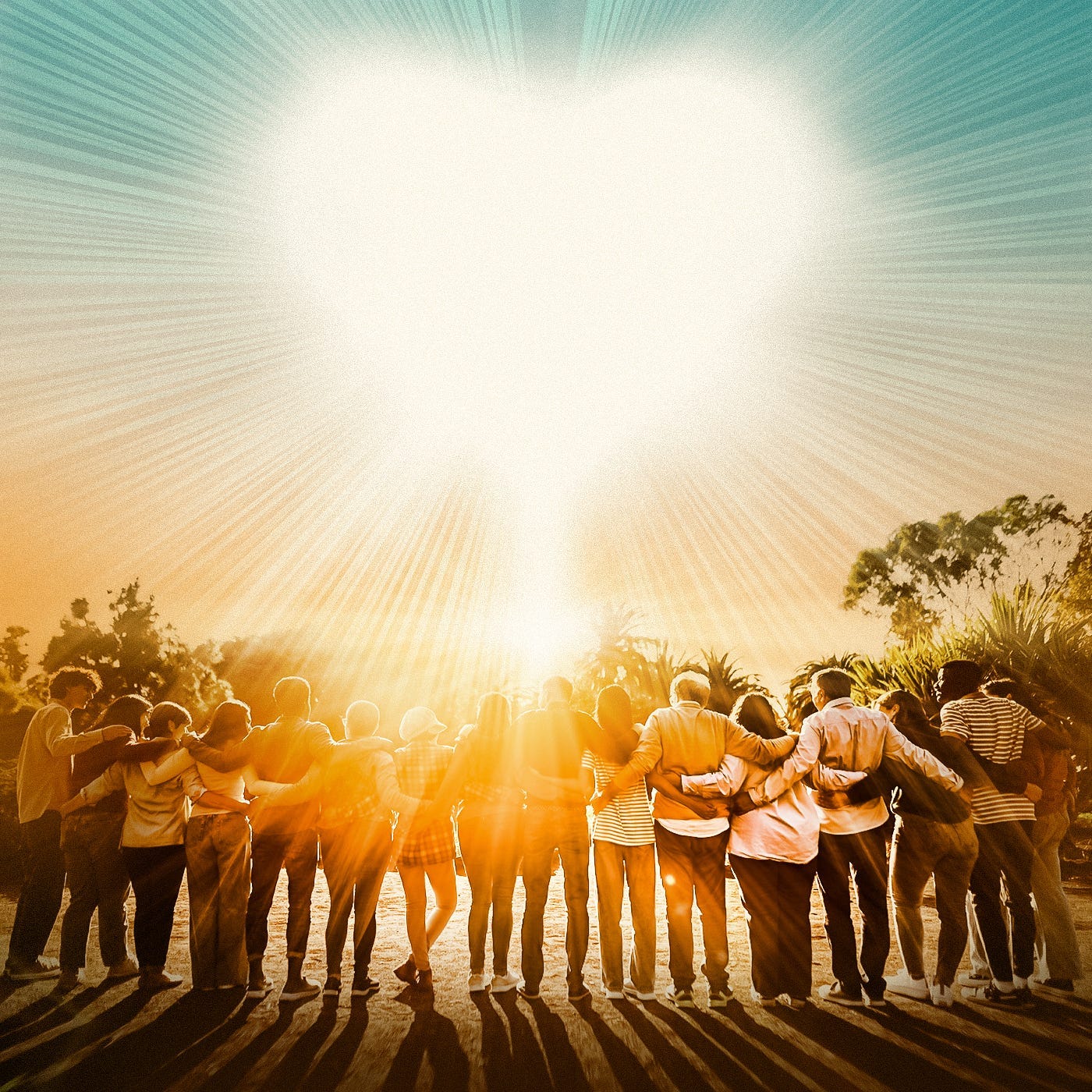
Remembering the Whole
I have spent much of my life discovering how deeply we are all connected. Yet even now, I still catch myself seeing people through my own prejudices and assumptions rather than recognizing our shared humanity and the connection we already have. That is why the Ancient Blueprint is not simply something I discovered. It is a Pattern I must continually remember and learn to live in alignment with. Every day. Every moment. Even as I write these words.
I have come to understand why.
We live as if we inhabit two worlds. One is the world of roles, identities, beliefs, institutions, competition, and division. The other is the deeper Transcendent reality I experienced as a child, where we are already connected and held within Love.
Yet the demands of everyday life can still draw our attention away from that deeper reality.
The deeper reality, in which life is held together in Love, has never left me. It has never left us. Any of us. But remembering that reality is not the same as living from it. And that is the challenge of building a Whole-Community Parallel Polis: remaining grounded in that Love while living in a world that operates as though we are separate from one another and from the sacred.
How we understand reality shapes how we live together. When we see people primarily through their roles, identities, and interests, we build communities around those differences instead of strengthening the relationships that already connect us.
At some point, we must move beyond blaming the Culture of Separation, politicians, the West, the world, our parents, or anyone else. Are we ready to take responsibility for the world’s suffering as our own? This does not mean taking on guilt or assigning blame. It means recognizing how deeply we see ourselves and others through separation. And then choosing to live differently. We cannot heal the world while remaining captive to the very divisions we seek to overcome.
Remembering the whole means recognizing that we already belong to one another, held together in a sacred reality deeper than our differences. Our challenge is to live from that connection, even with people whose beliefs, identities, and visions are profoundly different from our own.
The Whole is Already Here
Once we begin to see the world through the lens of the Transcendent, we can bring that same way of seeing to our churches, movements, organizations, political communities, networks, and worldviews. We see how naturally we organize around what matters to us, gathering people who share our vision and building coherence together. Yet we begin to see beyond our individual communities and recognize that we already belong to a much larger whole.
The whole community is already here. What is fragmented are the relationships that hold it together.
That changes what belonging means and where it begins. We already belong to something so much bigger than our separate identities, beliefs, and worldviews. Our belonging transcends the limits of what our rational minds can understand or agree upon. Through this, I now understand my experience of Divine Love more deeply.
That Love is already there, available to all of us, deeper than the divisions we create between us. Even when we cannot see it, it holds us within a deeper unity without requiring us to become the same.
I understand more deeply now what St. Paul means when he writes of Christ, “He himself is before all things, and in him all things hold together.”
We do not have to understand or name that deeper reality in exactly the same way. But we can learn to embody that deeper coherence in how we live together. Our work is to learn how to give that Love social form in the communities where we already live.
That’s why the whole community is not the destination. It is where we begin.
The Quiet Revolution is Already Underway
That realization brings me back to the farmer who began this story. “I’m already doing it,” he told me.
At the time, I interpreted his words as resistance. I was trying to connect the pieces, while he seemed perfectly content with what he was already doing. Years later, I finally understand what I could not see then.
His words now carry a deeper meaning. He was already doing it. So was the pastor, the activist, the business owner, the regenerative practitioner, the Christian, the network weaver, the entrepreneur, the neighborhood organizer, and the person working to transform consciousness. The good I was trying to bring together was already alive in countless people, communities, movements, cultures, and traditions.
And so was I. Each of us carries a piece of the good, but I need to remember that my piece is not the whole.
Each piece carries something real and necessary. The farmer has his farm, the pastor his church, the activist his cause, the entrepreneur her business to build. The problem is not that we carry different pieces.
The problem comes when we begin to treat our piece as the answer for everyone else. That is how even our efforts to do good reproduce the Culture of Separation: we begin to believe that our piece will transform the whole if only enough people join us.
Forty years of on-the-ground community work have brought me to a deeply personal realization: if my piece is not the whole, then I have to relate differently to the people carrying the other pieces.
That does not mean abandoning the work we are already doing to serve a higher cause. It means recognizing that our work is one vital part of a larger whole. We can do both simultaneously. We can remain deeply rooted in the traditions, convictions, relationships, and callings that give our lives meaning. The farmer can keep restoring the soil, the activist seeking justice, the artist creating, and the person of faith living deeply from their tradition.
From that realization comes a radical inversion of how we “change the world.”
Showing Up for the Whole Community
The inversion begins when we recognize our own work as part of a larger whole and begin working with others whose visions, priorities, and contributions may differ from our own.
Once I stop treating my piece as the whole solution, I stop seeing those who do not share my worldview primarily as people I need to change, persuade, recruit, compete with, defeat, awaken, or convert. They may be carrying gifts, knowledge, resources, and ways of seeing that the whole community needs, things I cannot see from where I stand but can learn to recognize, value, and care about.
Instead of asking, How do I get them to join “my thing”? I can begin asking: What good are they already carrying? What needs or possibilities can they see that I cannot? What might become possible when what each of us carries is brought into relationship in service to the whole community?
The inversion is simple but demanding: we stop asking others to join us and begin showing up for them. We bring our piece into relationship with theirs, listen for the good they are already carrying, and look for ways to serve what is already trying to emerge among us.
My encounter with the farmer gave me a deep lesson: we need one another to see the whole more clearly. I needed to see the good he was already carrying, and he needed to see how his piece connected to something larger.
Our work is not to make all those pieces the same or gather them beneath a single worldview, movement, or name. It is to recognize what is already among us and build the relationships that allow those pieces to find one another and contribute to the whole.
To do that, we have to cross the boundaries that keep us apart.
And that does not mean erasing our differences. A church can reach beyond its own walls into the wider community. A regenerative farmer can build a relationship with a conventional one. People with very different politics, beliefs, and ways of life can begin building relationships around the life they already share.
And we do not have to agree before we begin. Shared needs, such as food, children, livelihoods, health, and care for one another, give us common ground because they reach beneath the issues and positions that divide us.
These Common Needs are not another worldview we must adopt. They are places where different worlds can meet and begin taking responsibility for the life they already hold in common.
Pouring New Wine Into New Wineskins
But coming together is only the beginning. Connection by itself is not enough. We carry our assumptions, prejudices, wounds, and habits of Separation into the relationships, systems, and structures we create.
That is why Love has to become something we actually live between us.
That’s what I mean by Love as Structure: not merely a feeling, a private morality, or a personal virtue, but a reality embodied in how we live with one another: how we listen, serve, disagree, keep our word, practice courage and respect, and seek mutual benefit.
Love, Integrity, Courage, Service, and Respect are not merely good behaviors. They are ways Divine Love becomes embodied in how we live and relate to one another. And because Love takes form in how we live with one another, we do not have to wait for large institutions or systems to begin transforming the life we share.
We can begin where we are, with the people and places already around us.
And that is the beautiful simplicity of it: a few people can meet in a small circle, not to create another organization, but to deepen relationships, practice the Virtues, and ask how what each person carries might serve the larger community.
This is how the Pattern can take local form: people gathering in circles, building networks of relationship, uniting around a shared purpose of Love, practicing relational principles and Virtues, and acting around Common Needs. I came to call this pattern Symbiotic Culture DNA.
Aligning with the Ancient Blueprint does not require your organization or community to become Symbiotic Culture. A church remains a church. A business remains a business. A neighborhood group or government agency remains what it is. You can begin living the Pattern where you already belong, while others do the same within their communities.
In practice, a circle can begin within an existing church, business, neighborhood group, nonprofit, or other organization, much as an organization might host an AA group, bringing together people who already know and trust one another. It can remain rooted in that community while also becoming part of something larger.
The circle becomes a place of practice, a place to listen more deeply, live the Virtues, build trust, and learn another way of being together. As trust deepens within a circle, the Pattern can move outward. A few people can reach beyond their circle to churches, movements, businesses, neighborhoods, and other parts of the community. Those relationships can become bridges between worlds that have remained separate.
When those bridges multiply, circles form networks of relationships, what I have called symbiotic, mediating networks, that connect otherwise separated parts of the community. They are not formal organizations. Each remains rooted where it began while forming relationships with others across boundaries. Their purpose is not to promote themselves, but to help the larger community become more connected and capable of acting together.
Seen this way, Jesus’ image of new wine and new wineskins points to two radically opposing ways of organizing our common life: the patterns of Separation that sustain the empires of this world, or the relational architecture through which the life of the Kingdom can begin to become visible among us.
The old wineskin is made up of the organizing frameworks that keep us enclosed within our separate worlds and disconnected from one another. The new wineskin is a relational architecture that reconnects the separated parts of the community and allows them to become part of a larger whole.
And the new wine is Divine Love flowing through those relationships and taking social form in the life of the whole community.
When Divine Love Breaks Through
As those relationships grow, the good that was once fragmented begins to flow through the whole community. Trust, gifts, resources, opportunities, and capacities find their way across boundaries that had previously kept people disconnected.
People meet needs together, circulate resources, create new economic relationships, solve problems, and take greater responsibility for the life they share.
As these relationships and shared capacities grow, people become increasingly able to make decisions and shape the future of their community together. The Parallel Polis emerges from the relationships, networks, and capacities people are building among themselves.
The form this takes differs from community to community. One place may begin with food, children, or livelihoods; another with housing, health, land, spiritual life, or some other Common Need. Some communities may speak explicitly of God and Divine Love, while others may understand what is happening through different language and traditions.
None of them need to call it Symbiotic Culture. The Ancient Blueprint is bigger than any name we give it, and its expression takes shape through the unique culture, history, needs, gifts, and relationships of each community. That has changed how I understand my own work.
I no longer see my task as creating a model or movement for others to adopt. Symbiotic Culture is simply one contemporary way of naming and giving form to that universal Pattern.
The Blueprint is universal. Its expression is local. Instead of asking people to join what we are building, we begin asking how we can support the good work they are already doing.
And showing up for them does not mean abandoning our piece of the puzzle. We bring it with us. But instead of making it the organizing center for everyone else, we bring what we carry into relationship with what others already carry. We listen for what matters to them. We serve where we can. We participate in their good rather than only asking them to participate in ours. Then something can emerge between us that none of us could create alone.
This is how Divine Love, embodied in relationships, begins taking social form, growing civic and economic capacity and self-governance without becoming a single movement.
Imagine this happening not in one place, but in tens of thousands of communities across the world: a bottom-up eruption of Divine Love taking social form in different places while carrying the same ancient Pattern.
Years before I had language for any of this, Dr. Ari had expressed a remarkably similar vision:
“We dream of a world that is a commonwealth of self-governing communities. We dream of people enjoying participatory democracy, where all human rights are respected, spiritual and moral values are strong, and where people respect nature.”
Sarvodaya has already demonstrated that this vision can take practical form. It built a network of more than 5,000 communities within one nation, not through a global movement or centralized system, but through a grassroots effort that developed outside the political party system.
They showed that a commonwealth of communities is not a “pie in the sky” ideal. It can grow from the ground up, each community rooted in its own place and culture while participating in something larger.
This brings me back to the vision that has stayed with me since 1990, long before I understood the Ancient Blueprint. I saw the hearts of humanity reaching upward, and the Heart of Jesus Christ pouring Love into the world, flowing from person to person and community to community. Only much later did I begin to understand what that vision means socially: people gathering where we live, building relationships across our differences, and creating the relational structures through which Divine Love enters our common life.
And that leaves me with a larger question: what might happen if this occurred everywhere, at the same time, in forms native to different people and places, until it transformed the battlefields of our world?
Such an eruption might remain unnamed. Not because nothing was happening, but because no single movement could contain it or claim it. A church might recognize the Kingdom. A regenerative farmer might see healthier soil and a stronger community. Neighbors might simply call it neighbors helping neighbors. Others might give it no spiritual name at all.
No one needs to name it, own it, or possess the whole in order to participate. No movement needs to contain it. Each part can remain fully itself while becoming more deeply related to the whole.
The good is already here.
The deeper coherence is already here.
The Blueprint is already here.
The Kingdom is already breaking through among us.
Divine Love is not meant to remain only within us. It is meant to move through us, between us, and among us until it takes social form in the life we build together.
The greatest call of the Age is to give that Love social form together.
New Book: Recovering the Sacred Pattern of Common Life
Check our all the Discoveries:
Discovery 1: The Good Is Already Here
Discovery 2: The Coherence Is Already Here
Discovery 3: The Blueprint Is Already Here
Discovery 4: How Love Bridges Worldviews
Discovery 5: How Divine Love Takes Social Form
Discovery 6: How Love Orders Our Relations
Discovery 7: How Love Becomes Social Architecture
Discovery 8: How Love Enters Economic Life
Discovery 9: How Love Becomes People Power
Discovery 10: The Whole Community Is Already Here
To learn more about my first book, Birthing the Symbiotic Age: An Ancient Blueprint to Unite Humanity click HERE, or purchase below: